


As an Amazon Associate I earn from qualifying purchases. Some links in this post are affiliate links, at no extra cost to you.
People tend to treat a messy desk as a willpower failure. It is almost never that. It is that the things on the desk have nowhere better to go, so they stay where they were last used. This guide covers home office storage ideas step by step, with practical tips and product picks.
Give each category of clutter a home within arm’s reach and the desk stays clear without any effort. Pour aller plus loin : Home office.
The arm’s-reach rule
Anything you touch daily should be reachable without standing up. Anything you touch weekly can be across the room. Anything you touch less than monthly should not be in the office at all. For more on this, see our small Home office ideas for any room (2026) guide. For more on this, see our Home office lighting ideas that stop eye strain (2026) guide. See also: 35 aesthetic bedroom ideas for every style & budget (2026).
That sounds obvious, but most desks are the exact opposite — daily items buried in a drawer, and a stack of papers from March sitting in the prime real estate directly in front of you.
Spend ten minutes sorting what is on your desk right now into those three buckets. Most people find over half of it belongs in the third one.
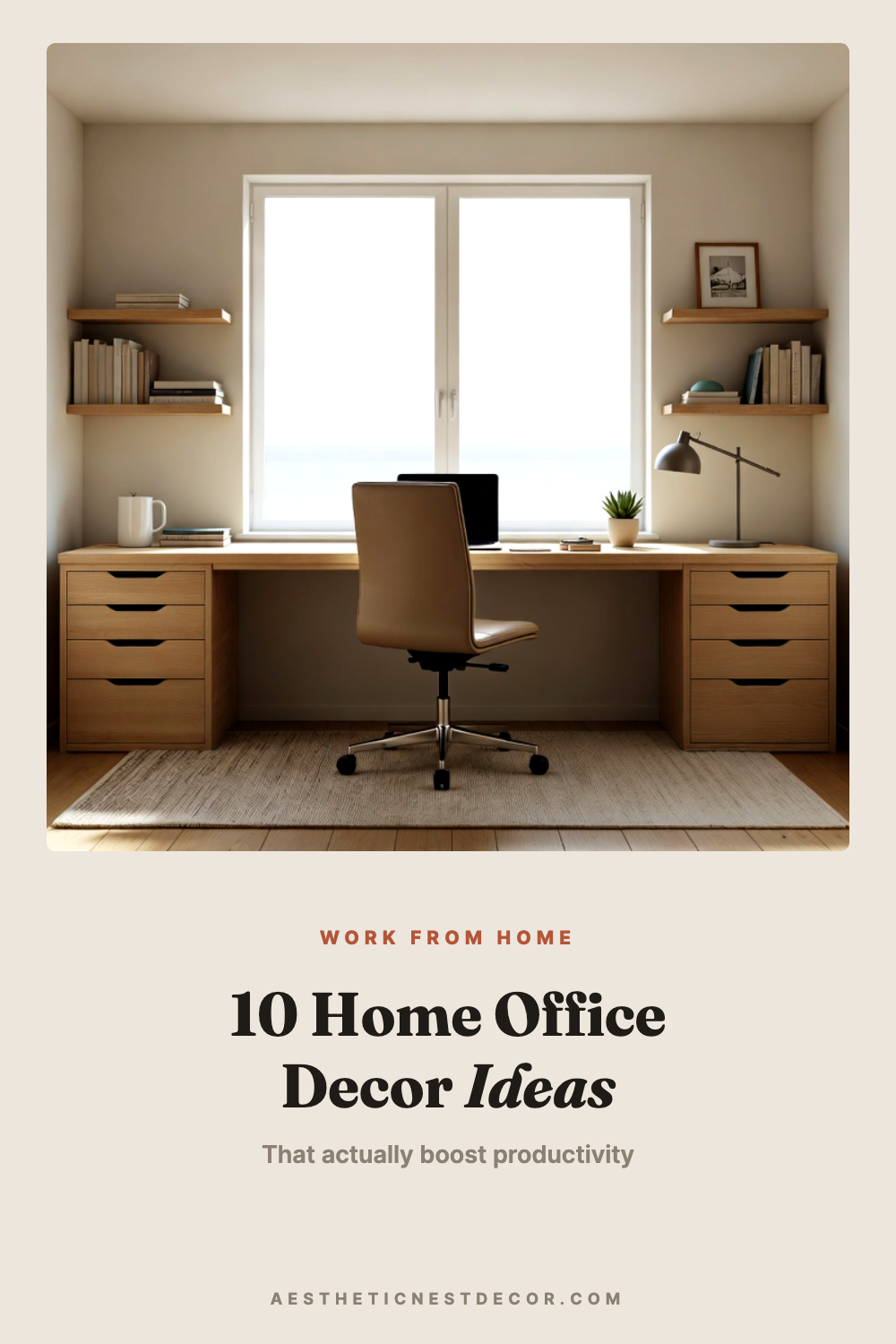
Go vertical before you go wider
The instinct when a desk gets full is to buy a bigger desk. That buys you about three weeks before the new surface fills up too.
The wall above the desk is free storage that costs no floor space. A single floating shelf, a pegboard, or a set of wall pockets for paperwork will take more off the desk than an extra 40cm of desktop ever does.
Keep the shelf sparse. Three or four items reads as intentional; a crammed shelf just moves the clutter up to eye level where you see it more.
Deal with cables once, properly
Cables are the thing that makes an otherwise tidy desk look chaotic, and they are genuinely quick to fix.
A cable tray screwed to the underside of the desktop holds the power strip and all the slack. Around $20 and it removes the entire visual problem in one go.
Add adhesive clips along the back edge for the two or three cables you actually unplug — phone charger, laptop lead — so they stay reachable instead of falling behind the desk every time.
Then leave it alone. Cable management fails when people try to re-do it every time something changes.
The paperwork system that survives contact with reality
Elaborate filing systems fail because they need maintenance. A three-tray system does not.
In — anything that has arrived and needs a decision. Active — the two or three things you are currently working on. Archive — a single box, not sorted, that gets emptied twice a year.
Most home paperwork does not deserve categorisation. It deserves a box and an annual cull. If you genuinely need to find a document from eighteen months ago, searching one box takes less time than maintaining a filing system for two years. See also: 10 Home office decor ideas that boost productivity.
Contain the drawer of miscellaneous things
Every desk has one drawer that everything falls into. The fix is not discipline, it is dividers.
Cheap drawer inserts turn one undifferentiated pit into four small defined areas. Things go back in the right compartment because there is an obviously right compartment, not because you have become a more organised person. If you want to go further, 15 small bedroom storage ideas that maximize space covers it in detail.
Our closet organization ideas apply the same principle at a larger scale if the office shares space with storage.
A Weekly Reset That Keeps Storage Working
The best home office storage ideas still fail without a simple routine. Set aside ten minutes at the end of each week to reset the desk: put loose papers into an inbox tray, return chargers and pens to their containers, and clear anything that does not belong in the room.
Use the reset to check whether your storage still matches how you work. If the same items keep landing on the desk, they need a closer home, like a wall shelf or a drawer organizer within arm’s reach. If a drawer has filled with things you have not touched in a month, move those items to a box in a closet.
Label containers on the inside of drawers and on the front of bins. Labels sound fussy, but they make it faster to put things back, which is the whole point of storage. A label maker or simple masking tape and a marker both work.
Finally, keep one empty bin or shelf on purpose. Storage that is packed to the edge leaves nowhere for new projects to go, and the overflow ends up on the desk again. A little spare capacity is what keeps a clear desk clear.
Frequently asked questions
What should actually stay on a desk?
The things you touch every day and nothing else — usually a laptop or monitor, a lamp, something to write with and one container for pens. Everything else has a better home within arm’s reach.
How do I hide cables under a desk?
Screw a cable tray to the underside of the desktop and put the power strip and all the slack inside it. Use adhesive clips along the back edge for the two or three cables you unplug regularly. It costs around $20 and takes half an hour once.
How do I organise paperwork at home without a filing cabinet?
Three trays: incoming, active, and a single unsorted archive box you empty twice a year. Most household paperwork does not justify a real filing system — searching one box occasionally costs less time than maintaining categories you rarely use.
Is a bigger desk the answer to a cluttered one?
Usually not. A larger surface fills up in a few weeks because the underlying problem is that items have nowhere else to go. Adding wall storage above the desk fixes it more reliably than adding desktop area. Related reading: best shoe storage ideas for your entryway.




2 Comments