
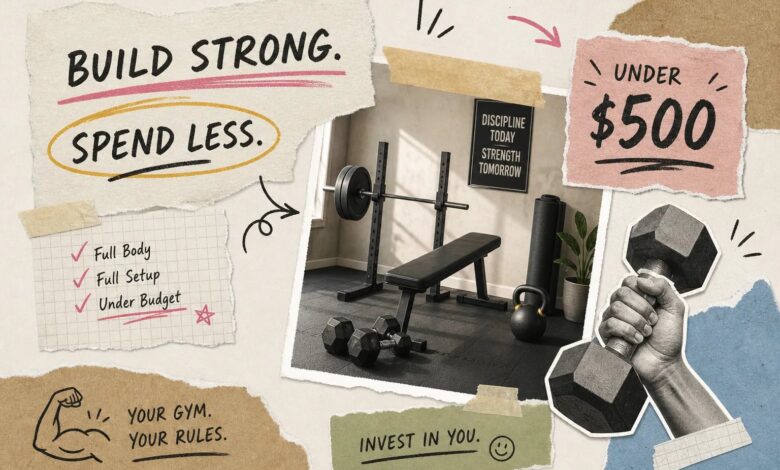
As an Amazon Associate I earn from qualifying purchases. Some links in this post are affiliate links, at no extra cost to you.
A gym membership in the United States runs about $50 to $100 per month in 2026, at the high end, that’s $1,200 a year, every year, for a commute, a locker room you share with strangers, and equipment you’re waiting in line to use. A one-time investment in a budget home gym changes that math significantly. You pay once, you own it, and you train on your schedule, though like any equipment, it may occasionally need maintenance or replacement over time.
This guide treats the workout space the same way we approach every other room at Aesthetic Nest Decor: with intention. That means covering the right gear, the right flooring, and the design touches that make a space feel like somewhere you actually want to be. By the end, you’ll know exactly what to buy, what to skip, and how to build a functional, great-looking budget home gym without blowing past $500.
Budget Home Gym Tiers: Choose Your Range Before You Buy
The biggest mistake people make when setting up a home gym is buying random gear instead of building a complete system. These three tiers give you a clear framework so you can set expectations before you spend a dollar. Whether you’re after a starter home gym kit or a fully loaded affordable home gym, knowing your tier upfront keeps you from overspending on gear that doesn’t serve your goals.
What a $100 setup looks like and what it can do
A resistance band set ($20, 40 for a stackable tube set with handles, door anchor, and ankle straps), a no-drill doorframe pull-up bar ($25, 40, with models like the Ally Peaks rated up to 440 lbs), and a yoga mat ($15, 25) give you a real training setup. This combination covers push, pull, squat, hinge, and core movement patterns. That’s not a toy kit. That’s the foundation most fitness programs run on. A beginner or someone maintaining fitness can run this cheap home gym setup indefinitely.
The $300 tier: where a home gym starts to feel serious
Adjustable dumbbells are the game-changing upgrade at this price point. The Bowflex SelectTech 552 (typically $249, 299 on sale) is the strongest all-around pick here. It carries a 5-year warranty, covers a wide weight range, and takes the place of an entire dumbbell rack. Pair it with your bands and pull-up bar and you’ve covered nearly every major movement pattern for full-body strength training. This trio is enough for a serious program, not just maintenance work.
Under $500: a complete gym most people will never outgrow
At the $500 tier, add a suspension trainer or gymnastics rings ($20, 50) and a compact adjustable bench ($80, 150) to the $300 setup. Now you have progressive overload across pressing, pulling, hinging, squatting, carrying, and core work. This isn’t a stepping stone to something better. It’s the ceiling most home gym users actually reach. You’d be hard-pressed to run out of training options with this home gym under $500 combination.
Budget Home Gym Equipment Picks for Full-Body Strength Training
Once you know your tier, the next question is which specific products earn your money. Here’s how to evaluate the most important purchases in your budget workout equipment lineup.
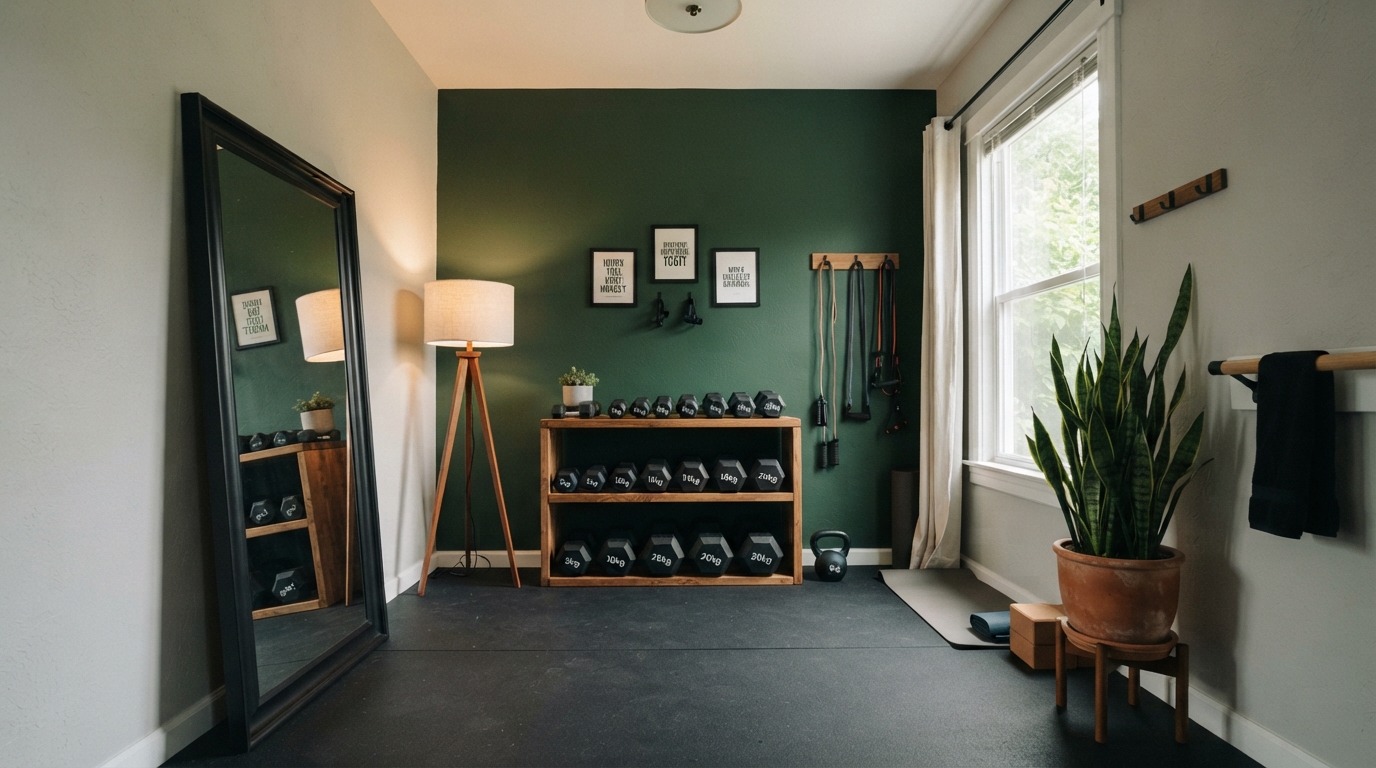
Adjustable dumbbells: which models are worth the money
Three options dominate the under-$300 space. The Bowflex SelectTech 552 is the most versatile all-around choice: a solid 5-year warranty, sturdy construction, and wide availability make it easy to recommend. The dial mechanism requires care and the weights shouldn’t be dropped, but for controlled home training it’s excellent.
The PowerBlock Sport or Elite-class models are the durability-first choice. PowerBlock advertises a 10-year warranty on Elite EXP-class models, and the compact design ages better under heavy, repeated use. The FLYBIRD is the right call if you’re on a tighter budget and training at lighter loads, a capable set, just not the best choice for heavy long-term training. Pick based on how hard you train, not just on price.
Resistance bands and a pull-up bar: the foundation that covers everything
A quality stackable tube band set ($25, 40, with options like Bodylastics or WHATAFIT including handles, a door anchor, and ankle straps) and a sturdy no-drill pull-up bar together cover as many movement patterns as many single machines under $500, often more, since bands handle warm-ups, accessory work, and beginner progressions across every muscle group. The pull-up bar fills the vertical pulling gap that no other low-cost gym equipment handles as well. If you only buy two things, buy these two first.
Compact benches: when to add one and what to look for
A bench becomes the right upgrade at the $300, 500 tier because it multiplies the number of exercises you can do with dumbbells. The FLYBIRD Adjustable Weight Bench folds flat and earns strong stability reviews. The Bells of Steel Flat Utility Bench is the best compact flat option with zero wobble during use. The PASYOU Adjustable Weight Bench is the top strict-value pick, often available under $100. Prioritize stability and flat-fold storage over extra incline settings you’ll rarely use.
Affordable cardio options that won’t eat your floor space
Cardio equipment is where most people either overspend on machines they stop using or skip entirely. The best choices on a budget depend on your training style and tolerance for impact.
Jump rope and mini stepper: best raw value for calorie burn
A speed or weighted jump rope (under $30) delivers the highest calorie burn per dollar of any cardio tool. The tradeoff is that it requires coordination and involves joint impact, which isn’t ideal for everyone. A mini stepper (around $50) is lower-impact, nearly silent, and takes up almost no floor space. One or both of these belong in any $100, 300 tier setup if you want cardio without a dedicated machine. They earn their spot on pure value alone.
Budget folding rower vs compact air bike: for serious cardio on a budget
If you want a machine, the folding magnetic rower at around $250 for entry-level models is the best full-body cardio machine for small spaces at the $300, 500 tier. It folds and stores vertically against a wall, which matters if you’re working with a spare room or one-car garage. The compact air bike at around $400 is the better choice if you want shorter, harder sessions: it delivers a stronger calorie burn in less time and has a smaller footprint than a rower during use. Go with the rower for longer endurance work; go with the air bike if you prefer high-intensity intervals.
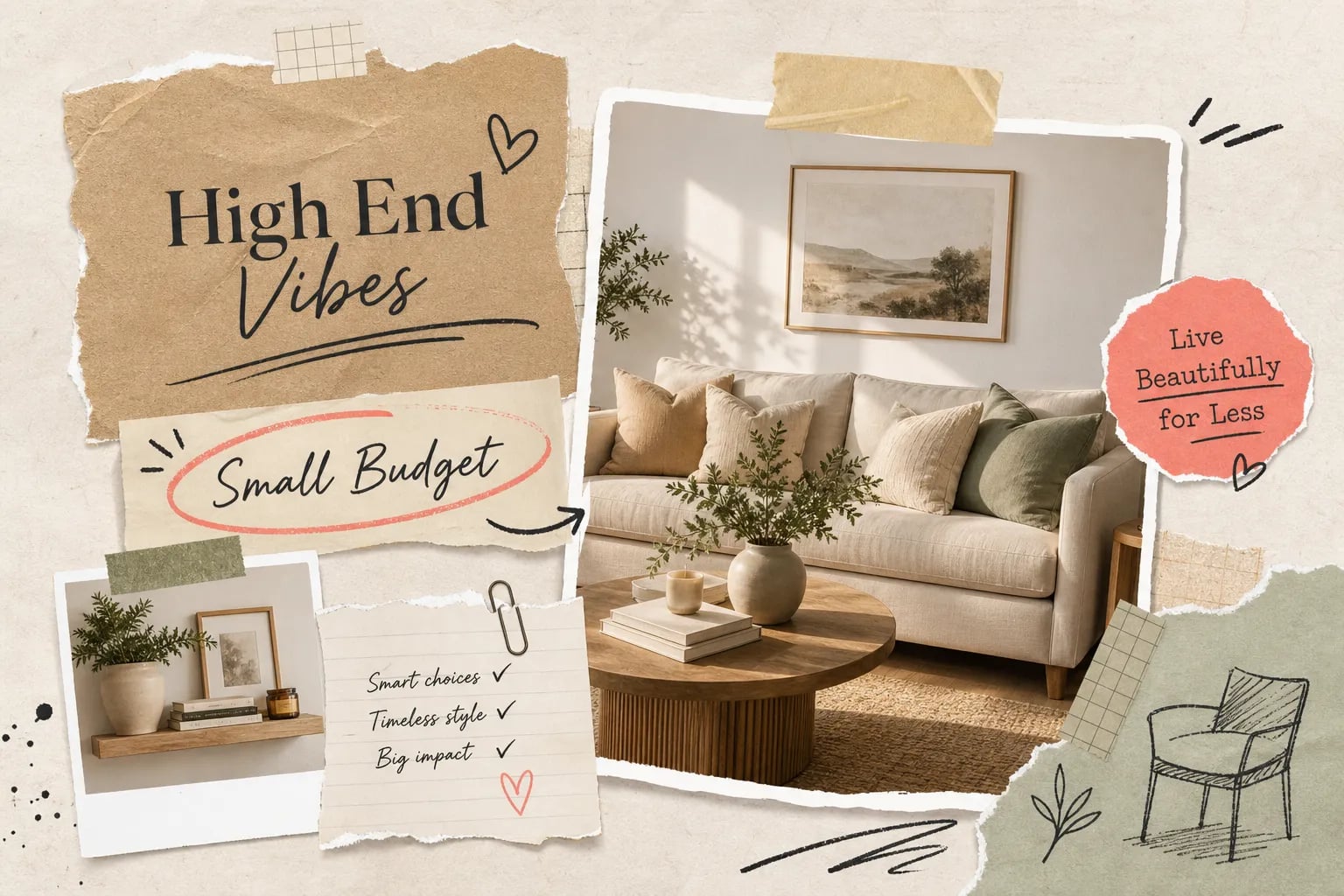
Budget Home Gym Flooring: Protect Your Floors and Your Joints
Flooring is the most overlooked line item in a home gym budget. Skip it and you’ll regret it the first time a dumbbell dents your subfloor or your feet slip during a squat.
Rubber gym tiles vs foam mats: which is actually worth it
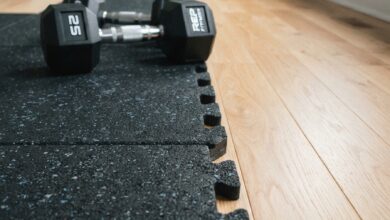
Rubber interlocking tiles (typically $2.25, 2.50 per sq ft for entry-level options from brands like Greatmats or American Floor Mats) are more durable, easy to clean, and handle the weight of dumbbells and benches without compressing. Foam puzzle mats are cheaper (around $0.50, 1.00 per sq ft) but compress under heavy loads and don’t hold up long-term. The direct recommendation: rubber tiles for any setup that includes dumbbells or a bench, foam mats only for pure bodyweight or stretching routines. Don’t cheap out on the surface you’re training on every day.
How much flooring you actually need and what it costs
A 6×6-foot area (36 sq ft) covers a solo strength training zone comfortably. A more practical standard is 8×8 feet (64 sq ft), which gives you room to move around equipment without feeling cramped. At $2.25, 2.50 per sq ft for rubber tiles, that works out to roughly $144, 160 for the 8×8 setup. If you’re in a garage, horse stall mats from Tractor Supply Co. are the best heavy-duty alternative: the standard 4×6-foot, 3/4-inch vulcanized rubber mat runs around $50, 55 each and handles anything you’d drop on it. Three mats cover a solid lifting zone for roughly $150, 165; four mats approach $200, 220 depending on your local price.
Make your home gym feel intentional, not like a storage room
A space you actually want to spend time in is a space you’ll use consistently. The design side of a home gym isn’t about aesthetics for their own sake, it directly affects how often you train.
Simple design touches that actually improve how often you train
A full-length mirror does double duty: it adds visual depth to a small space and lets you check form during lifts. A single motivating piece of wall art costs almost nothing but changes how a room feels the moment you walk in. Organized storage for bands, small accessories, and remotes, a wall hook strip or a small bin on a shelf, eliminates the friction of hunting for gear before a workout.
Lighting is one of the highest-impact, lowest-cost improvements you can make: a basic LED shop light in the $25, 40 range transforms a dim garage corner into a professional-feeling training space. None of these are luxury upgrades. Together, they shift the room from “corner with weights” to a space with a clear purpose.
Where to find gym styling ideas that go beyond the gear list
Most equipment guides stop at the gear and ignore the room entirely. At Aesthetic Nest Decor, our home gym design guides cover what those guides skip: how the space looks and feels, not just what’s sitting on the floor. If you want specific ideas for styling a workout space on a tight budget, including wall treatment ideas, lighting layouts, and compact storage solutions, our home gym content is built around real spaces with real constraints. Search “home gym design” on Aesthetic Nest Decor to find guides that match your setup type, whether that’s a spare bedroom, a garage corner, or a basement partition.
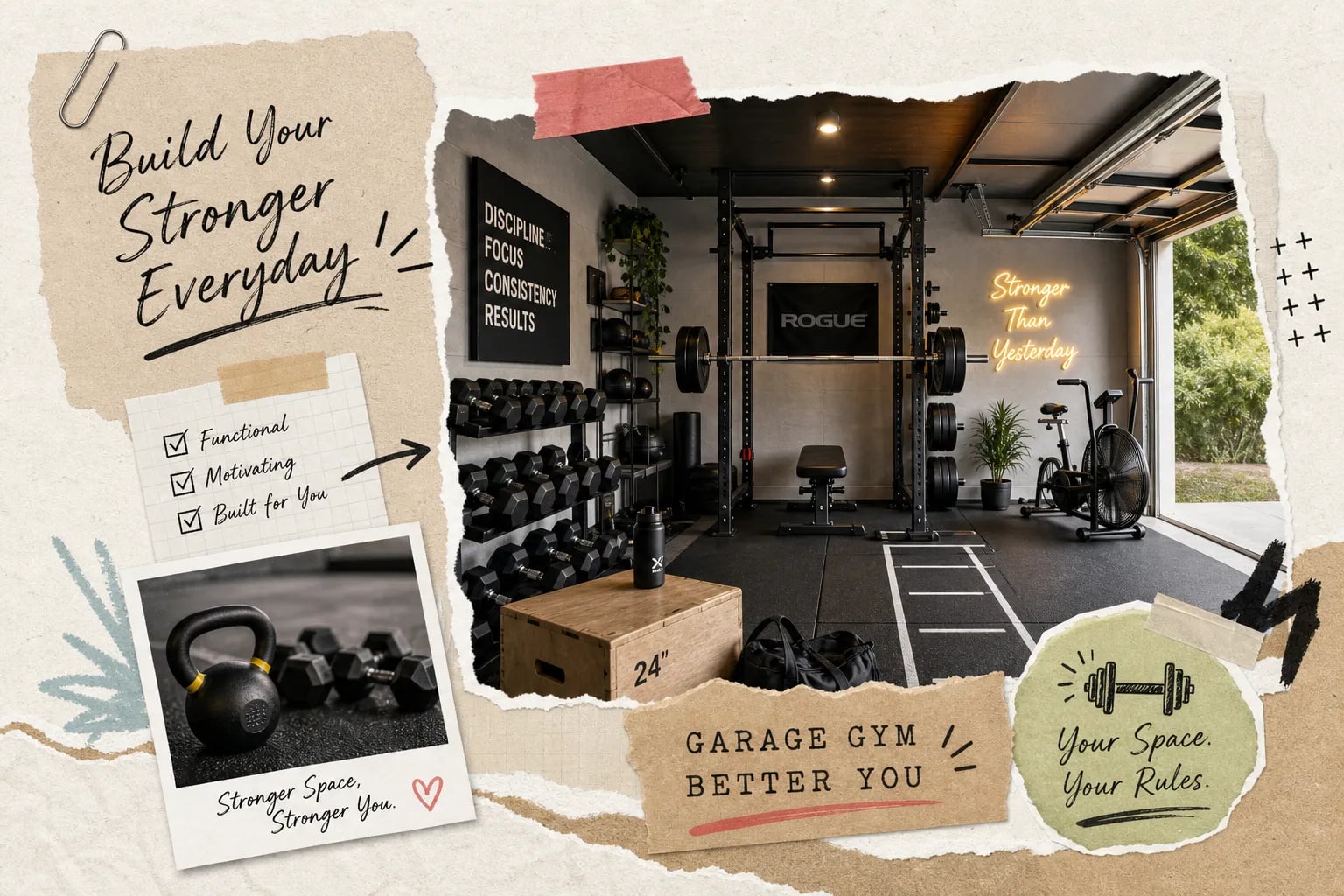
Where to buy new or used equipment and what fair prices look like
Knowing what to buy is half the job. Knowing where to buy without overpaying is the other half.
New gear: where to find the best prices and deals
Amazon is the most reliable source for adjustable dumbbells, resistance bands, and pull-up bars, with competitive pricing and easy returns. Dick’s Sporting Goods and Walmart carry budget benches, mats, and basic accessories at fair prices. For warranty-backed purchases, buying direct from the brand’s website locks in the product warranty more cleanly than third-party sellers. Timing matters: the two best windows for deals are New Year’s (January) and back-to-school season (August, September), when gym equipment promotions are reliably strong.
Used gear: realistic pricing and what to watch for
Facebook Marketplace, OfferUp, and Craigslist are where patient buyers save serious money. Used barbells typically run $40, 150 for standard bars; iron plates go for roughly $0.50, 1.00 per pound; home-use squat or power racks run $100, 400 depending on condition and style. A $500 new-gear budget can often be replicated for $200, 250 with used equipment if you’re willing to wait for the right listings. Watch for specific red flags: rust on barbell sleeves (sleeve integrity matters), cracked welds on racks (a structural failure risk), and compressed foam padding on benches (stability and longevity suffer). Check photos carefully, ask for video of moving parts, and negotiate based on condition.
Start with the tier that fits your life right now
The best budget home gym is the one you actually build and use. Start with a tier that fits your current budget and space, don’t wait until you can afford something bigger. A $100 bands-and-bar setup trains you every bit as effectively as a $5,000 garage gym on a budget if you show up and do the work. Add equipment as your budget and goals grow.
Pick your tier and buy the right combination of versatile home gym essentials. Put down proper flooring, then spend a little time making the space feel intentional. That last part matters more than most people expect, a room that looks good and feels purposeful is one you walk into willingly instead of avoiding.
Start your budget home gym today by picking a tier and committing to versatile gear you’ll actually use. If you want help with the design side once your gear is in place, Aesthetic Nest Decor’s home gym guides cover what the equipment lists don’t: how to make the room itself work for you.