

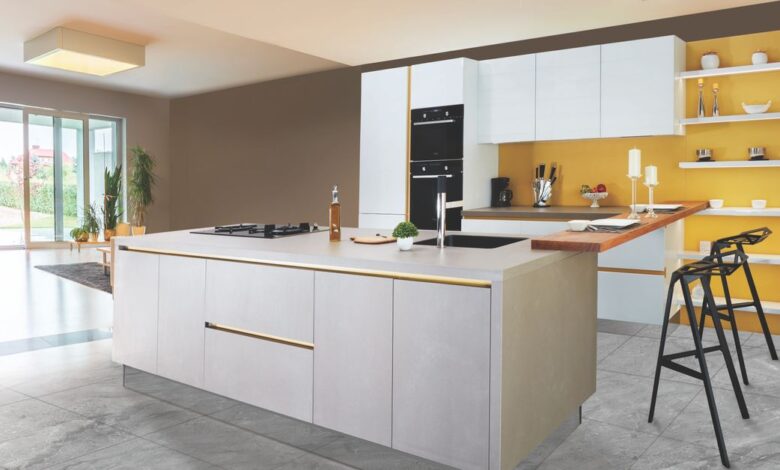
Why Your Entryway Matters More Than You Think
These entryway decor ideas will help you transform even the smallest foyer into a stylish, welcoming space that makes a great first impression. Your entryway is the first thing guests see and the last thing you see before you leave the house. It sets the tone for your entire home. Yet it’s one of the most neglected spaces in most houses — often reduced to a pile of shoes, a coat hook, and whatever mail landed on the nearest surface. Pour aller plus loin : entryway & mudroom.
As an Amazon Associate I earn from qualifying purchases. Some links in this post are affiliate links, at no extra cost to you.
These entryway decor ideas will help you transform even the smallest foyer into a stylish, welcoming space that makes a great first impression every single time.
These entryway decor ideas will help you transform even the smallest foyer into a stylish, welcoming space that makes a great first impression every time.
The good news: entryways are usually small, which means they’re fast and affordable to decorate. Even modest changes — a new rug, a mirror, a small console table — can completely transform the feeling of your home’s entrance. Here’s everything you need to know about creating an entryway that makes a genuinely great first impression.
Entryway Decor Ideas: Start With a Console Table
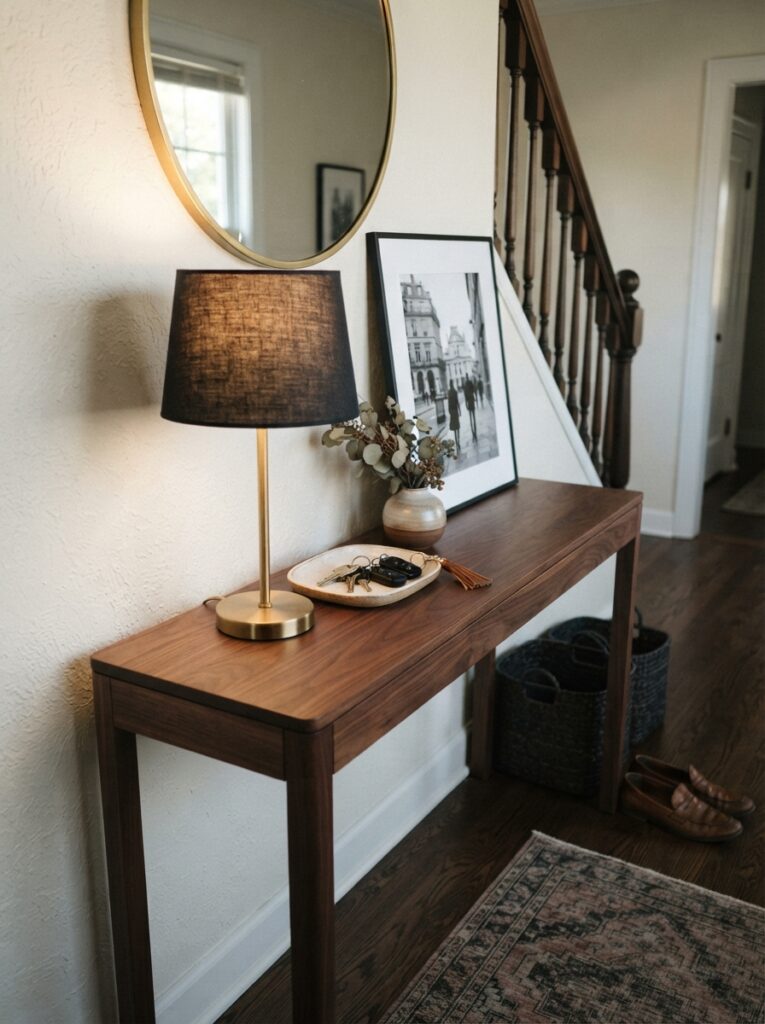
If you can fit one piece of furniture in your entryway, make it a console table. A slim console takes up very little space but gives you an enormous amount of decorating potential. Use it to display a lamp, a vase of fresh flowers, a small tray for keys, and a piece of art leaned against the wall behind it.
For small entryways, look for console tables that are 12 inches deep or less — they’ll fit without blocking foot traffic. A bench with storage underneath is another great option if you need a place to sit and remove shoes.
Add a Mirror to Make the Space Feel Bigger
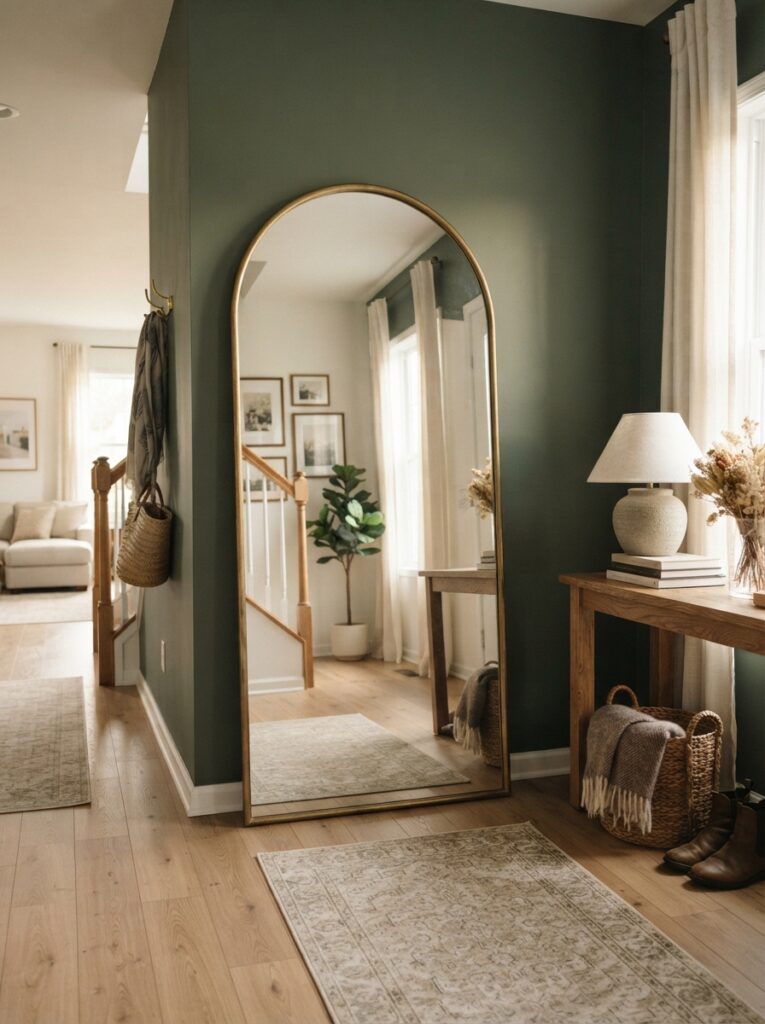
A mirror is non-negotiable in an entryway. It makes the space feel larger and brighter, and it gives you one last chance to check your look before heading out. Lean a large floor mirror against the wall for a relaxed, modern look, or hang a statement mirror — an ornate vintage frame, a sunburst design, or a simple arch-shaped mirror — above your console table.
Position the mirror to reflect natural light if possible, which will make your entryway feel airy and welcoming rather than dark and enclosed.
Layer Your Lighting
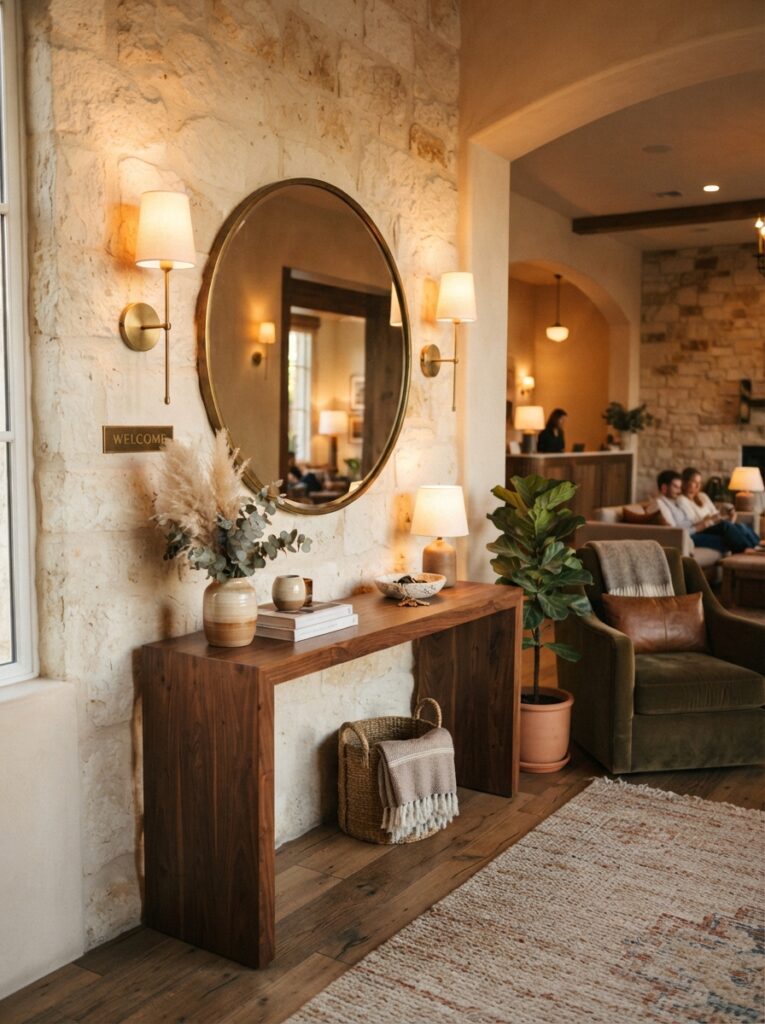
Entryways are often poorly lit, which makes them feel unwelcoming. Fix this with layered lighting: a ceiling fixture (even a simple pendant or semi-flush mount) plus a table lamp on your console. If you can’t hardwire anything, a plug-in sconce on either side of a mirror adds an elegant, hotel-lobby feel with no electrician required.
Warm-toned bulbs (2700-3000K) make entryways feel cozy and inviting. Avoid cool white or daylight bulbs in this space — they can make even a beautifully decorated entryway feel cold and clinical.
Choose the Right Entryway Rug
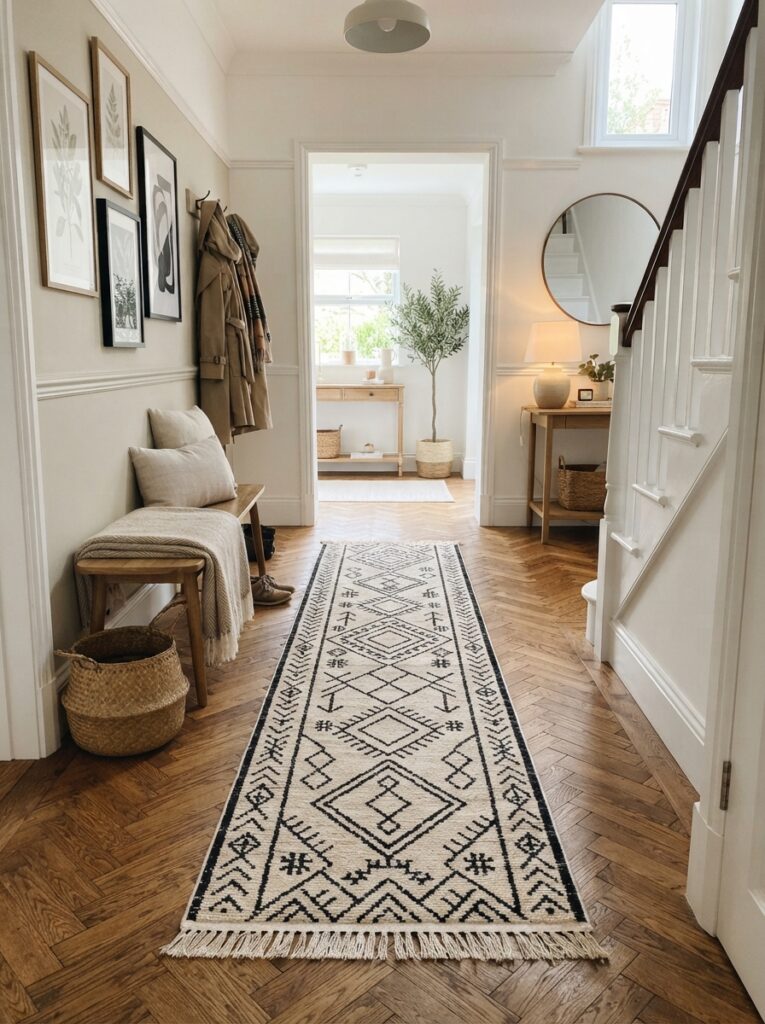
An entryway rug does double duty: it’s functional (protecting your floor from dirt and moisture) and decorative (anchoring the space and adding color or pattern). Choose a rug that’s durable and easy to clean — flatweave, indoor-outdoor, or low-pile options are best for high-traffic entry zones.
For size, your rug should be wide enough to fit under the front legs of any furniture you have, and long enough to give guests room to stand on it. In a hallway-style entry, a runner rug works beautifully — it elongates the space and draws the eye deeper into your home.
Create Functional Storage
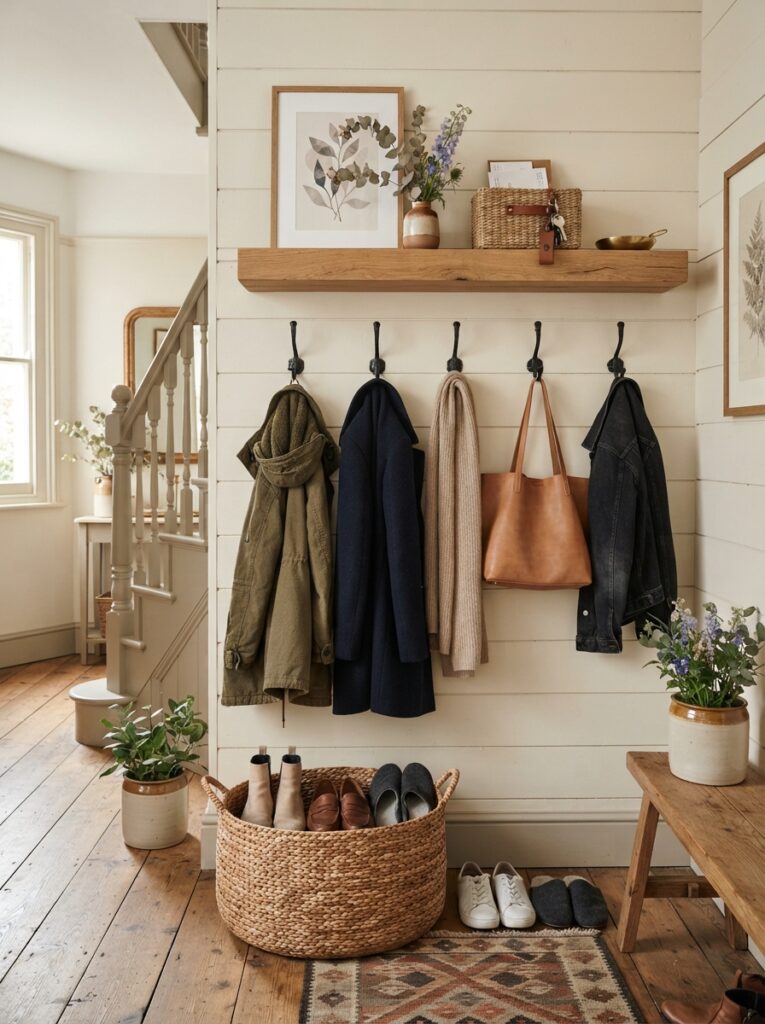
Beautiful entryways aren’t just decorative — they work hard. Think about what you actually need when you walk in the door: a place for keys, somewhere to hang coats, storage for shoes, and maybe a spot for bags or umbrellas.
A few solutions that look great and function even better: a floating shelf with hooks below for coats and bags, a small bench with a storage compartment underneath for shoes, a decorative tray or bowl on the console for keys and sunglasses, and a wall-mounted hook rack that doubles as a design feature rather than just a utility item.
Entryway Decor Ideas by Style
Modern Minimalist Entryway
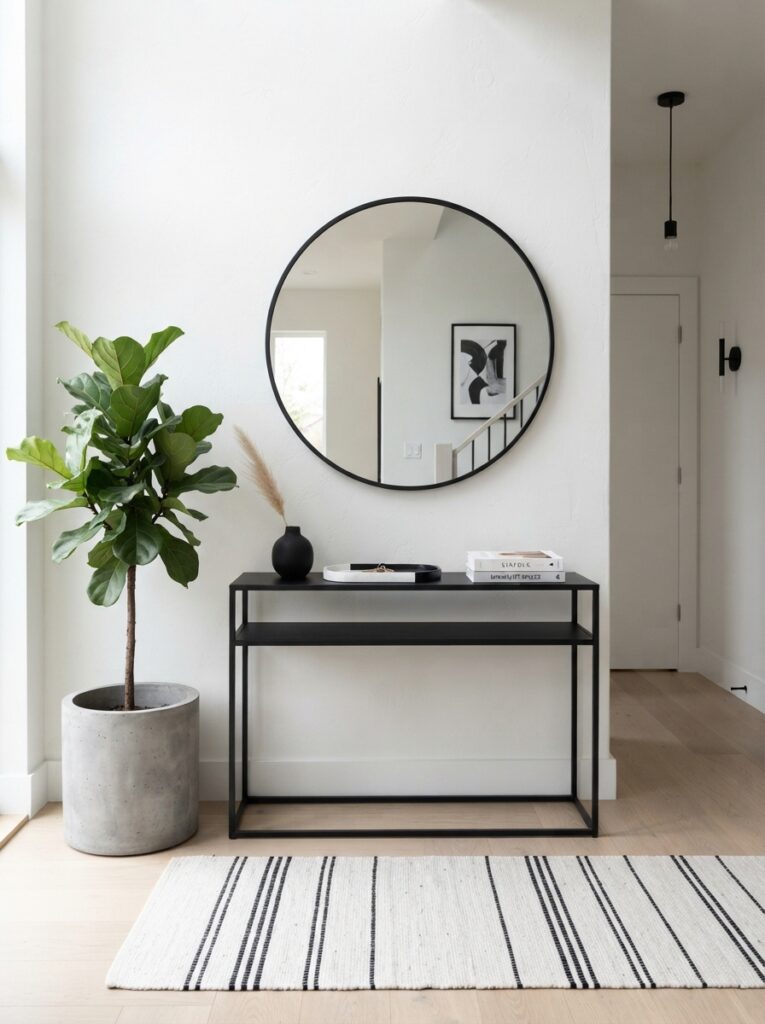
Keep it clean and edited. A sleek console in black or natural wood, one large mirror, a single architectural plant (like a snake plant or fiddle-leaf fig), and a simple geometric rug. No clutter, no excess — every piece has a purpose.
Boho Entryway
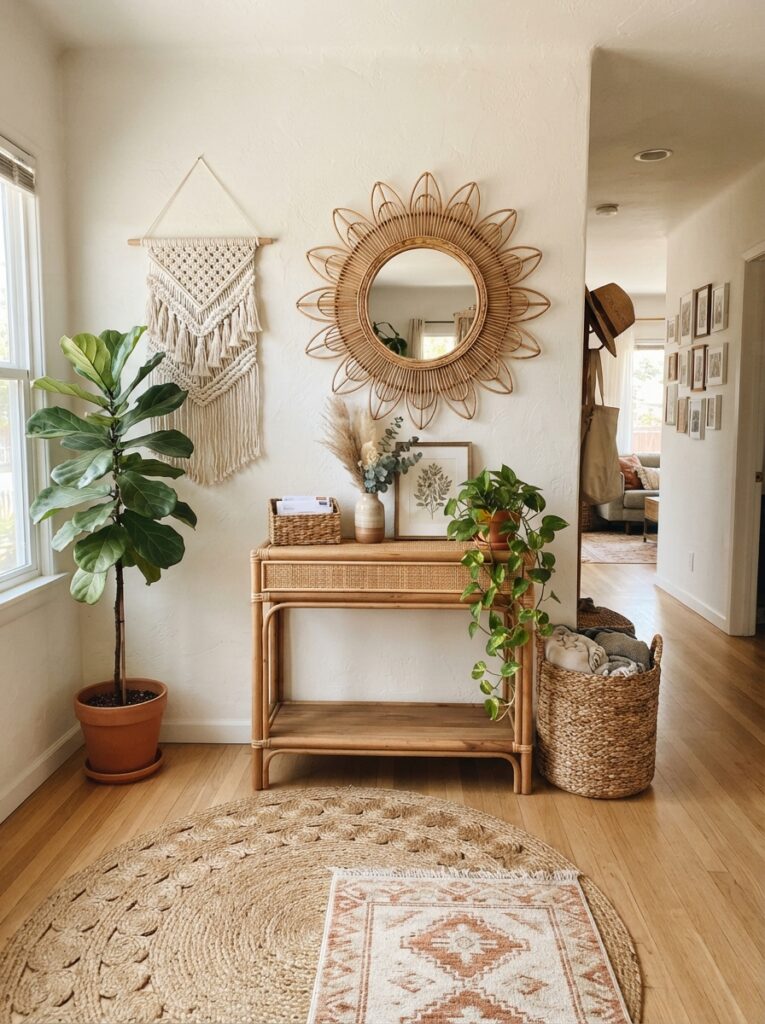
Layer textures and embrace warmth. A rattan mirror, a jute rug, a small woven basket for umbrellas, a macramé wall hanging, and a trailing pothos on a shelf. Natural materials and warm lighting are key.
Traditional or Classic Entryway
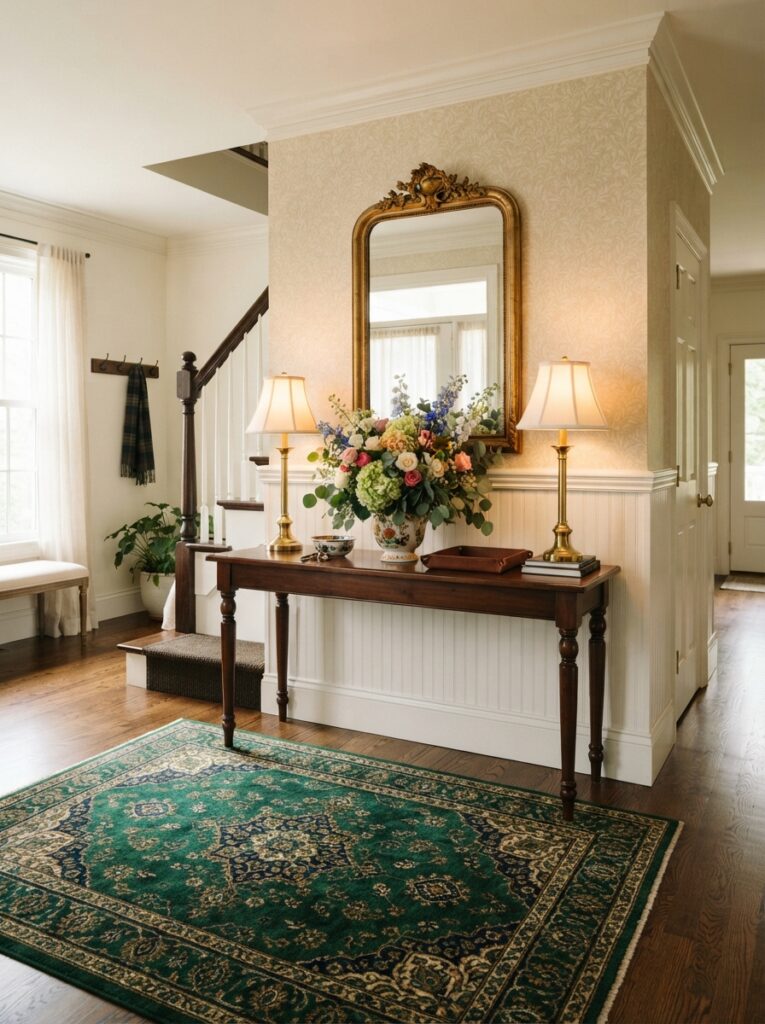
Go for symmetry and elegance. Matching lamps flanking a console mirror, a floral arrangement, wainscoting or picture-rail molding on the walls, and a patterned area rug in deep, rich tones. Classic doesn’t mean stuffy — it means considered and timeless.
Modern Farmhouse Entryway

Mix shiplap (real or faux), wrought-iron hooks, a galvanized metal bucket for umbrellas, a chunky jute rug, and a wooden bench with a cushion in a neutral linen fabric. Warm, welcoming, and effortlessly stylish.
Small Entryway? No Problem.
If your “entryway” is essentially just the 18 inches of floor between your front door and your living room, you can still create an intentional, beautiful space. A few tricks: For more inspiration, visit House Beautiful.
- Go vertical. A tall, narrow mirror, a floating shelf high on the wall, hooks mounted above head height — use vertical space to create visual interest without taking up floor area.
- Use the door itself. Over-the-door organizers, a hook on the back of the door, or even a mirror mounted on the door can reclaim space you didn’t know you had.
- Keep the floor clear. In a tiny entryway, floor clutter is the enemy. Wall-mount everything you can — keys, coats, shoes (in a slim wall-mounted rack).
- Choose a statement piece. Instead of filling a small space with many small things, invest in one beautiful, bold piece — a large mirror, a striking piece of art, a colorful rug — and let it do all the work.
Entryway shopping list
- Entryway bench — somewhere to sit and remove shoes
- Wall mounted coat hooks — two heights if you have kids
- Entryway console table — the drop zone that stays tidy
- Key holder tray — solves the daily search
- Boot tray — contains the wet
- Entryway runner rug — takes the grit
Prices and availability change. Links open on Amazon.
Entryway Decor Mistakes to Avoid
- Skipping the rug. Hard floors without a rug make entryways feel unfinished and loud. A rug is always worth it.
- Too much furniture. A cramped entryway stresses you out before you’ve even taken your coat off. If it doesn’t fit comfortably, don’t force it.
- Neglecting the smell. Your entryway sets the sensory tone for your whole home. A reed diffuser, a candle, or even a hidden plug-in freshener makes a bigger difference than you’d expect.
- Ignoring the ceiling. A statement pendant light or a coat of contrasting paint on the ceiling can transform even a plain entryway into a dramatic, memorable space.
Seasonal Entryway Decor Ideas
Because entryways are small, they are one of the easiest spaces in a home to refresh seasonally without much time or expense. A wreath on the door and a small pumpkin or two on the console table shift the whole entrance into fall in minutes. Winter calls for a bit of greenery, a bowl of pinecones, or a single string of warm lights around a mirror frame. Spring and summer favor lighter textiles on a bench cushion, a vase of fresh flowers, and swapping a heavier winter rug for something lighter underfoot.
Because the entryway is the very first thing guests experience, seasonal touches here read as especially welcoming, even when the rest of the home hasn’t been updated for the season yet.
Bringing Plants Into the Entryway
A single well-chosen plant does more for an entryway than almost any other decor element, since it adds life and softness to what is often an otherwise hard-surfaced, transitional space. Low-light-tolerant plants like a snake plant, ZZ plant, or pothos are ideal for entryways, which frequently get little direct sun. A tall plant in a floor-standing pot can fill an awkward empty corner, while a small potted plant on the console table adds a touch of green at eye level without requiring much space.
If your entryway genuinely gets no natural light at all, a well-made faux plant is a perfectly reasonable substitute — a lifeless real plant does less for the space than a convincing artificial one.
Coat Closet and Storage Solutions Near the Entryway
If your entryway includes a coat closet, how it’s organized affects how the whole entrance feels, even when the closet door is shut, since an overflowing closet inevitably spills out into the visible entry space. Matching hangers, a shoe rack on the floor, and a designated bin for hats, gloves, and scarves keep the closet functional enough that things actually get put away instead of dropped on the console or floor. For entryways without a closet, a slim armoire or wardrobe placed just inside the door can serve the same function, especially in older homes that predate built-in coat closets.
A small bench that opens for storage is one of the most efficient entryway pieces available, since it provides seating for putting on shoes and hidden storage in the same footprint.
Budget Entryway Makeover
An entryway refresh doesn’t require replacing every element at once. If you can only do one thing, add a mirror — it has the single biggest impact on how open and finished the space feels for the lowest cost. After that, a rug and a few coats of paint in a fresh color make the next biggest difference. Thrifted or secondhand consoles, benches, and mirrors are especially easy to find, since entryway furniture tends to be small and simple, both of which make it more common at resale shops and estate sales than larger furniture pieces.
Spray paint is your best friend for a budget entryway makeover: mismatched hardware, dated light fixtures, and old picture frames can all be unified with a single can of paint in a color that matches your new palette.
Entryway Ideas for Apartments Without a Real Entryway
Many apartments open directly into the living room with no defined entry space at all. In this situation, you can still create the feeling of an entryway by designating a small zone just inside the door — a narrow console or a wall-mounted shelf immediately to one side of the entrance, a rug that marks the transition point, and a hook or two on the nearest wall. Even without architectural separation, these elements psychologically signal “this is where you arrive” and “this is where the living space begins,” which does a lot to make an open-plan apartment feel more intentional.
A folding screen or a tall bookshelf placed perpendicular to the door can also create a soft visual divider between an entry zone and the rest of an open floor plan, without the cost or commitment of an actual wall.
The Sensory Details That Make an Entryway Feel Finished
Beyond what you can see, an entryway also sets a sensory tone through scent and sound the moment someone walks in. A reed diffuser or a simple bowl of dried botanicals with a few drops of essential oil adds a welcoming fragrance without an open flame near a high-traffic doorway. A small chime or bell on the door, while optional, adds a pleasant auditory cue that some people find surprisingly grounding. Keeping the space free of shoe odor with a designated tray or small basket for shoes, ideally with a breathable liner, prevents one of the most common ways an otherwise beautifully decorated entryway can undercut itself.
Final Thoughts
Your entryway deserves as much attention as any other room in your home. It’s the first story your space tells, and it sets the mood for everything that comes after. Start with a rug, a mirror, and one source of warm light — then build from there. You’ll be amazed how much a polished, intentional entryway changes the feeling of coming home.


5 Comments