

As an Amazon Associate I earn from qualifying purchases. Some links in this post are affiliate links, at no extra cost to you.
Most home office advice assumes you have a room going spare. Most people do not. What they have is a corner of a bedroom, an awkward hallway recess, or a bit of the living room that is currently doing nothing useful. For more on this, see our Home gym guide. You will find more ideas in Home office lighting ideas that stop eye strain (2026). For more on this, see our 10 Home office decor ideas that boost productivity guide. This guide covers small home office ideas step by step, with practical tips and product picks.
The good news is that a small workspace is mostly a dimensions problem, not a design problem. Get the measurements right and a 90cm corner can work better than a badly planned spare room. For more on this, see our bedroom ideas for 2026: style, color & small-space tips guide. Related reading: 15 small bedroom storage ideas that maximize space.
Start with the depth, not the width
People shop for desks by width and then wonder why the setup feels cramped. Depth is what actually determines whether a desk is usable.
A desk needs 60cm of depth minimum if you use a monitor, because your eyes want to sit roughly an arm’s length from the screen. At 45cm you will be too close and you will feel it within an hour. If you only use a laptop, 50cm is workable. However well your desk fits, sitting all day still takes a toll, so keep a few desk stretches that undo a day of sitting in your routine.
Width is far more forgiving. A 100cm desk is genuinely enough for a laptop, a notebook and a mug. You only need 120cm or more if you run two monitors.
The three layouts that work in small rooms
Almost every small workspace comes down to one of three arrangements.
The corner desk. Two walls do the work, and you get more usable surface per square metre than any other layout. The catch is that you face into a corner, which some people find claustrophobic. A mirror or a piece of art directly in front of you fixes that cheaply.
The wall-facing desk. Simplest option and the easiest to make look tidy, because everything can be mounted on the wall in front of you. Best in a bedroom, where you want the desk to disappear visually when you are not using it.
The float. A desk placed with its back to the room, so you face outward. This needs more floor space and only makes sense if the room has a decent view or good natural light to look at. It also means the back of your desk is on show, so cable management stops being optional.
Use the wall, not the floor
In a small workspace the floor is the resource you cannot get back, so put everything you can above the desk instead.
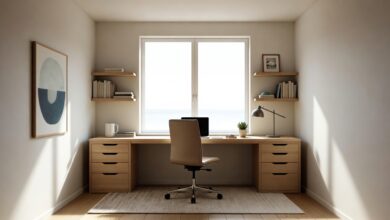
A single floating shelf mounted 40–45cm above the desktop clears your surface without hitting your head when you lean forward. Two shelves start to feel oppressive in a small room; one shelf plus a pinboard reads much lighter.
The same logic applies to lighting. A clamp lamp or a wall-mounted swing arm gives you a proper task light without spending any desk area on a lamp base.
Make it stop looking like an office at 6pm
This is the part that gets skipped, and it is the difference between a workspace you tolerate and one you do not resent. If the desk lives in a bedroom or living room, it needs an off switch.
The practical version: one closed box or basket that everything work-related goes into at the end of the day. Cables tucked into a tray under the desktop. A lamp you actually want on in the evening, so the corner reads as part of the room rather than as an office annexe.
If you are working in a bedroom in particular, this matters for sleep as much as for looks. Our guide to aesthetic bedroom ideas covers keeping a bedroom restful when it has to do two jobs.
What to spend on and what to skip
If the budget is tight, the chair is where it should go. You will feel a bad chair every single day, and a good one lasts a decade. A cheap desk with a good chair beats the reverse every time.
Worth the money: the chair, one decent task lamp, a monitor riser if you use a laptop for hours.
Not worth it in a small space: a large desk you will fill with clutter, a filing cabinet you will use twice a year, matching furniture sets that eat floor area for the sake of looking coordinated.
Small Home Office Ideas by Room Type
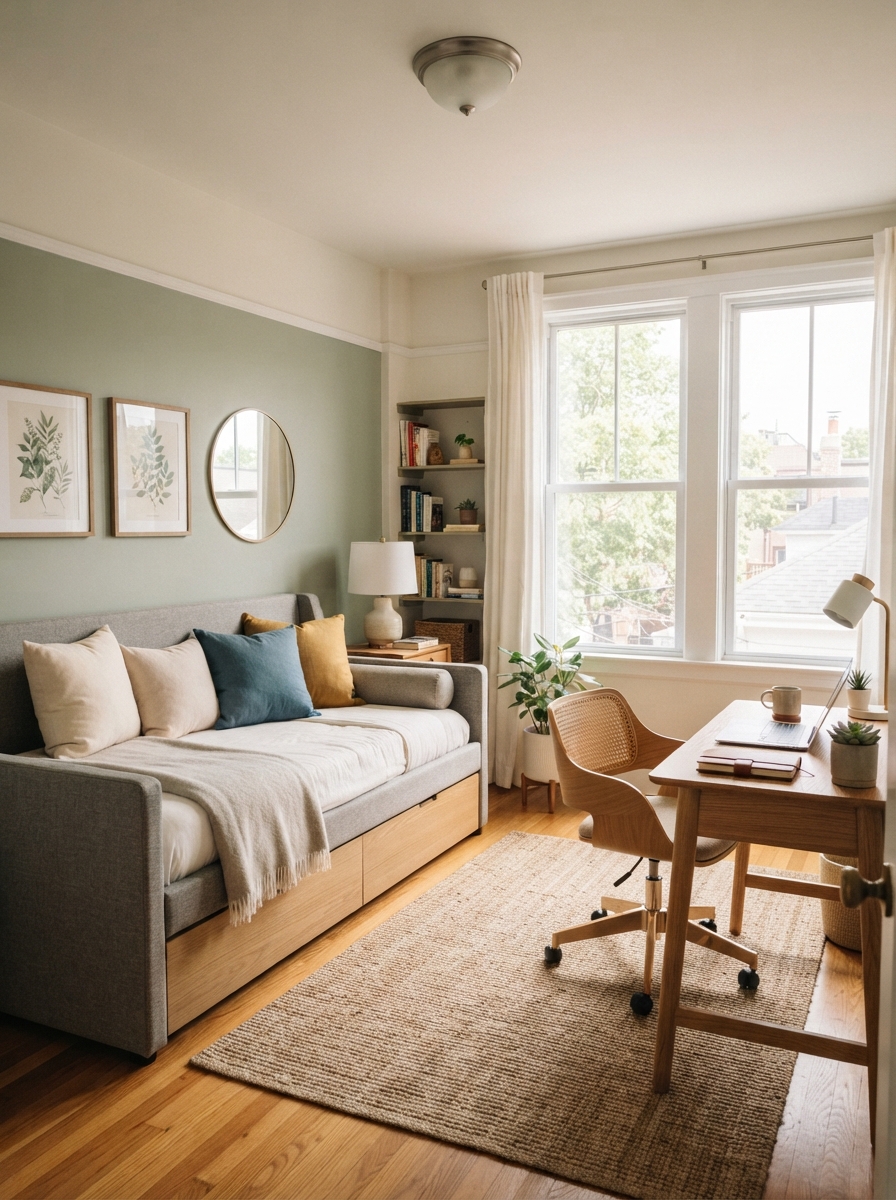
A spare bedroom, a living room corner and a bedroom nook each ask something different of small home office ideas. In a spare bedroom you can commit to a full desk wall, add a wall-mounted shelf above it and treat the closet as storage for paper and printer supplies. Keep the bed or sofa bed facing away from the desk so the room still works for guests.
In a living room corner, the desk has to look like furniture first. Choose wood or a painted finish that matches the rest of the room, use a chair that could pass as a dining chair, and hide the monitor cable behind a plant or a slim bookshelf. A closed cabinet or a lidded basket for the laptop at night makes the corner disappear after work hours.
In a bedroom nook, light matters most. Put the desk where daylight hits from the side, use a lamp with a warm bulb so the evening glow does not feel like an office, and keep the surface clear enough that it does not compete with the calm of the bedroom.
Whatever the room, measure the depth you can spare before buying anything. A 20 to 24 inch deep desk is enough for a laptop and a monitor arm, and anything deeper eats into walkways faster than you expect.
Frequently asked questions
What is the minimum size for a home office desk?
Around 100cm wide by 60cm deep is the practical minimum for monitor work. You can drop to 50cm deep for laptop-only use, but going below 60cm with a monitor will put the screen uncomfortably close to your face.
Can I put a desk in my bedroom without ruining the room?
Yes, provided it has a way to switch off visually. Keep the desk in the same colour family as the rest of the room, store work things in one closed container, and give the corner a warm lamp so it reads as part of the bedroom in the evening rather than as an office. You will find more ideas in curtain and window treatment ideas to elevate any room. You will find more ideas in Home library and reading nook ideas for any room.
How high should a shelf be above a desk?
40 to 45cm above the desktop. Lower than that and you will hit it when you lean forward; much higher and you cannot reach the shelf while seated, which defeats the point. For more on this, see our shelf decor ideas: how to style any shelf like a pro guide.
Is a corner desk better than a straight one?
For pure surface area in a small room, yes — a corner desk uses two walls and gives you more usable space per square metre. The trade-off is that you face into a corner, so hang something worth looking at in front of you. For more on this, see our small laundry room decor ideas that look as good as they work guide.




4 Comments