
Your coffee corner decor deserves better than a counter space that gets wiped down as an afterthought. A coffee nook, when it’s styled with intention, becomes the one spot in your kitchen that actually feels like yours. It’s the first thing you walk toward in the morning, and when it looks good, that matters more than you’d think.
At Aesthetic Nest Decor, room-by-room styling starts with function first. The coffee corner is one of the most satisfying spaces to get right because the payoff is immediate and the footprint is small. You don’t need a full kitchen renovation or a designer’s budget to build something that looks curated and works beautifully every day.
This guide covers five layers of a well-decorated coffee nook: choosing your style, planning your layout, styling your shelves, organizing appliances, and adding the finishing touches. By the end, you’ll know exactly what to do, what to buy, and how to put it all together.
1. Pick your coffee corner style before you buy anything
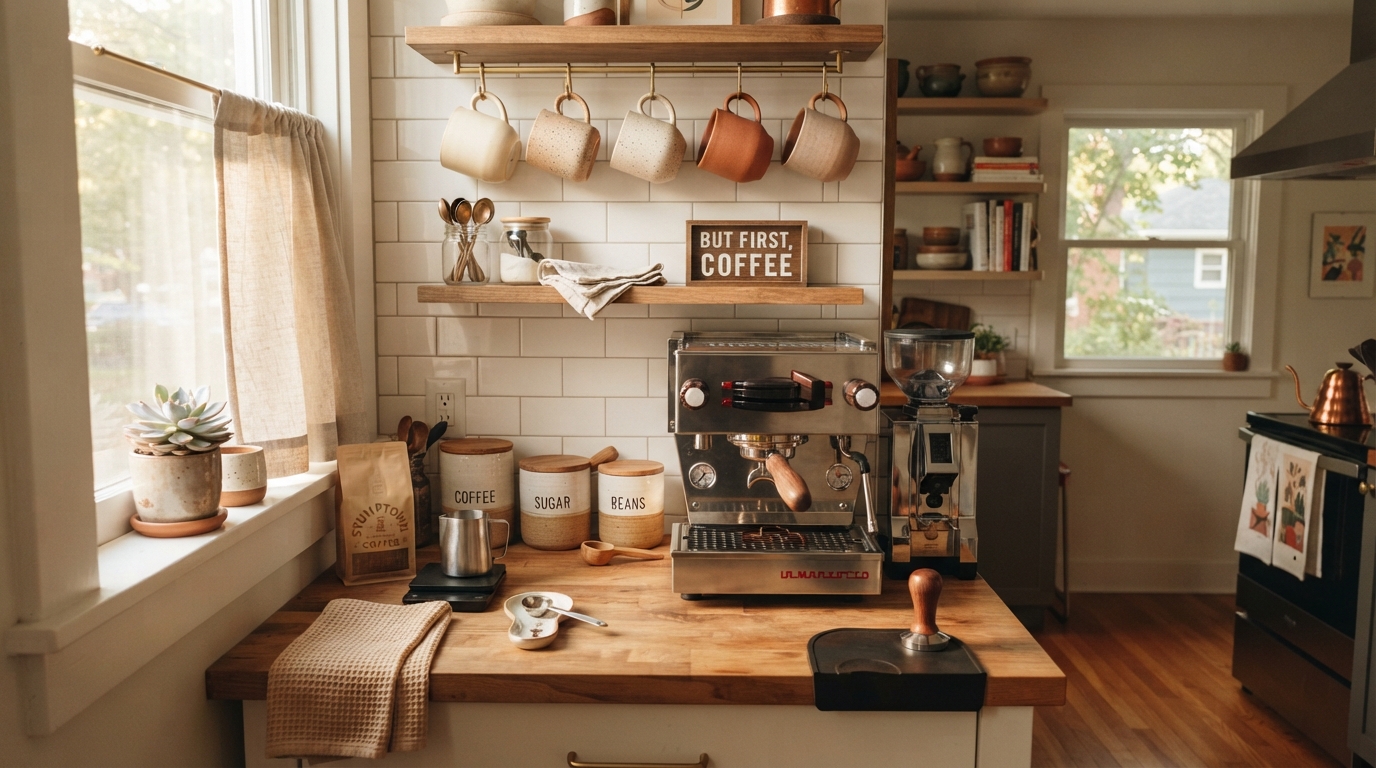
The fastest way to end up with a cluttered, mismatched nook is to shop without a clear style direction. When you know your aesthetic, every purchase decision gets easier. Everything you bring in works together instead of competing for attention. There are four coffee corner styles that resonate most right now, and you’ll know which one is yours within a minute of reading them.
Warm minimalist nook
This look is built on light wood shelving, matte finishes, hidden canisters, and a soft neutral palette. It reads clean without feeling cold, and it’s the best choice for small kitchens where any visual clutter registers as chaos. The goal is calm and intentional, not sparse and stark.
Cozy café-inspired corner
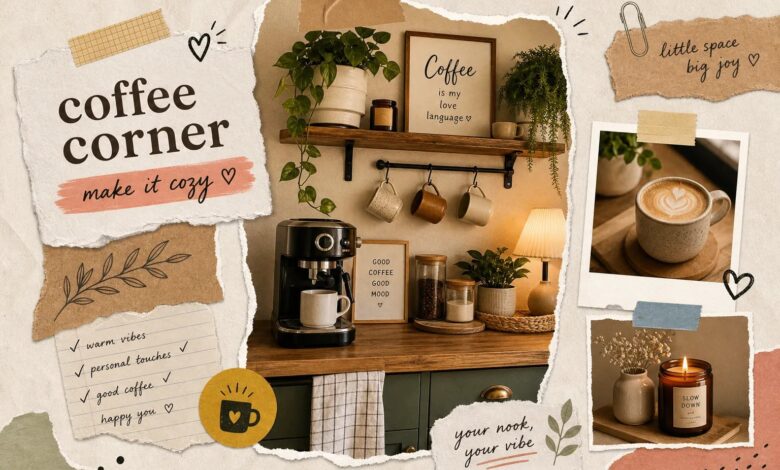
This is the most expressive of the four styles. Layered warm lighting, an open mug display, curated signs, and rich warm tones combine to make the nook feel like a destination rather than a utility station. If you want your coffee corner to feel like a tiny neighborhood café, this is your style.
Organic and earthy station
Stone or quartz countertops, terracotta or olive accents, trailing plants, and natural textures define this look. It works especially well paired with wood floating shelves and dark matte hardware. Think warm, grounded, and slightly imperfect in a way that feels very much alive.
Modern luxury setup
Marble or quartz surface, mixed metals, and built-in or concealed appliances give this style its polished finish. It’s the most elevated look of the four, and it’s entirely achievable on a budget with targeted material swaps in the right places.
2. Plan your coffee corner decor layout and shelf placement before decorating
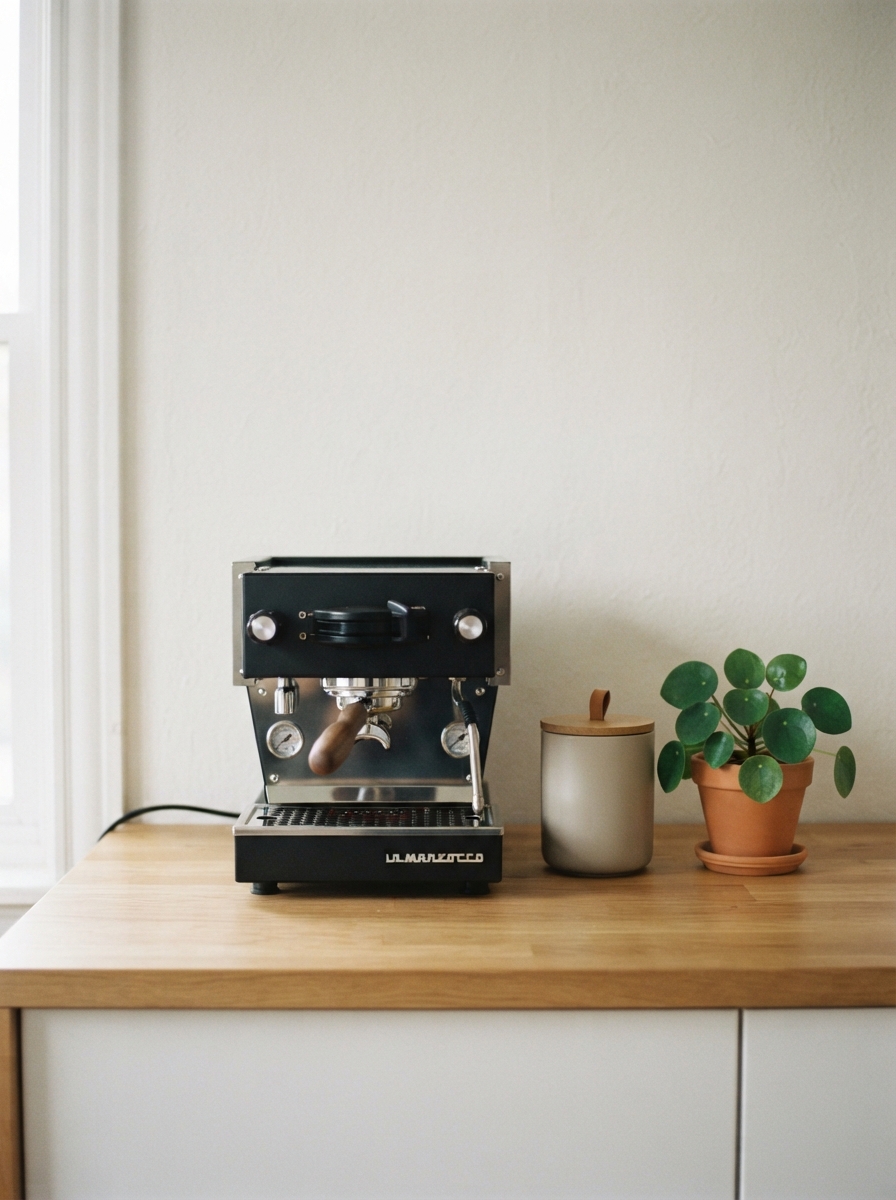
In most cases, coffee nooks fall short not because of bad taste but because the layout wasn’t planned before the styling started. Knowing your counter dimensions and shelf placement before you buy a single decorative piece saves you from returns, rearranging, and the frustration of a setup that never quite works. Start with your machine, then build outward.
Space requirements by machine type
A single-serve machine fits comfortably in 18 to 24 inches of counter width with 12 to 14 inches of depth, which leaves room for a mug, a small tray, and a pod container. An espresso machine with a grinder needs 24 to 36 inches of width and 18 to 24 inches of depth, giving you room to tamp and work. A pour-over station runs efficiently at 24 inches wide and 14 to 16 inches deep, especially if you store your kettle on a shelf above rather than on the counter.
Choosing the right shelf for above the machine
Shallow floating shelves at 6 inches deep and 12 to 24 inches wide are the most versatile option for a coffee corner. The IKEA LACK shelf at 43 by 10 inches works well for a wider nook, while a tiered U-shaped shelf set (available in 12, 16, and 20-inch widths, all at 6 inches deep) adds layered height in a compact footprint. Narrow wall cabinets, typically 8 to 10 inches deep, are a solid hidden-storage alternative if you want to keep the counter visually clear.
The one-shelf-too-many mistake
Often, three half-styled shelves look less intentional than one or two shelves styled with care. Visual crowding is the most common problem in coffee bar setups, and it’s almost always caused by adding more shelving than the space or the styling plan can support. Pick one or two shelves, fill them well, and stop there.
3. Style your shelves and set up a mug display that actually works
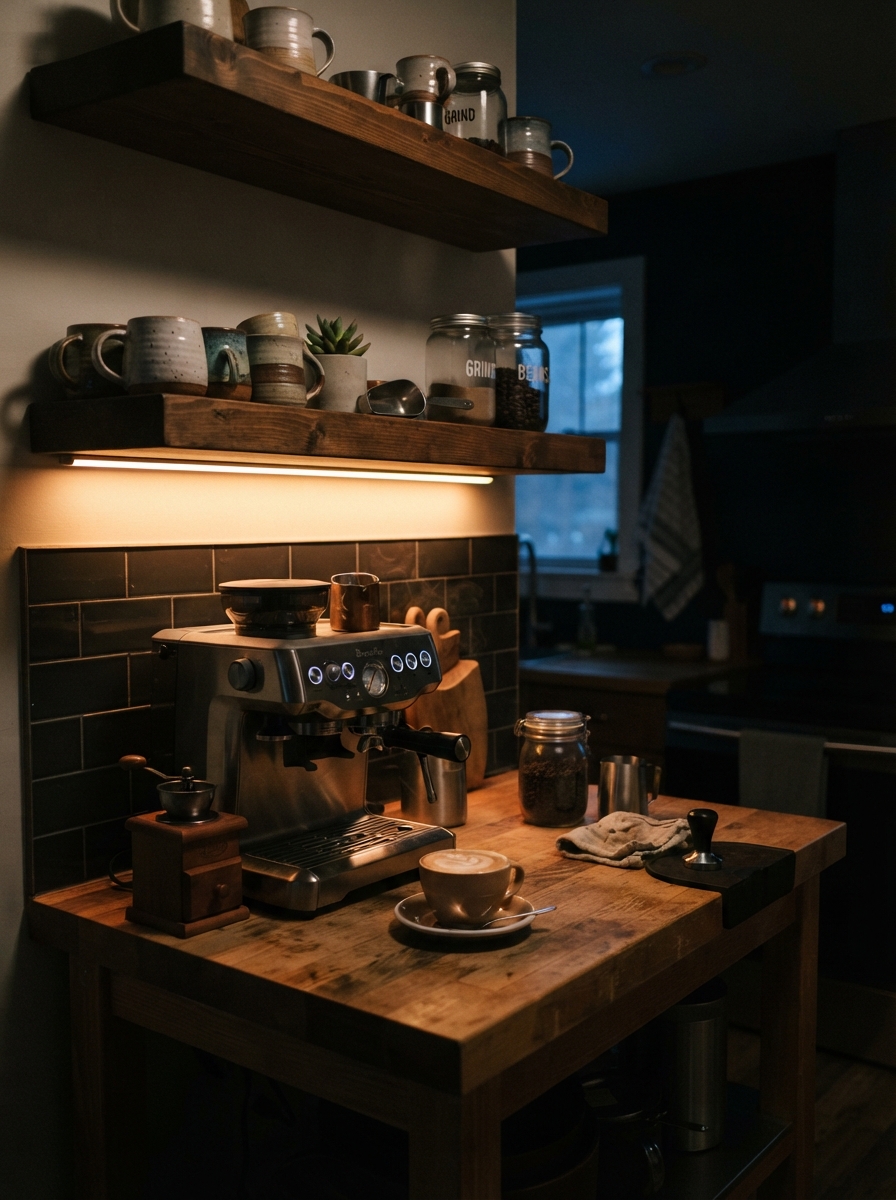
Open shelves above a coffee corner are where the whole look either comes together or falls apart. The principles behind café-style open shelf styling are simple, but most people skip them and go straight to arranging, which is why so many coffee shelf displays feel random rather than deliberate.
The layering formula for open shelves
Start with your tallest item, whether that’s a canister, a vase, or a small plant, and place it at one end of the shelf. Drop down to a mid-height piece like a stacked mug or a small jar, then anchor the other end with something flat or low. Varying the material is just as important as varying the height: ceramic next to wood next to metal reads as intentional, not random. Leave some negative space so the shelf can breathe.
Mug hooks vs. open racks: which works better in a small coffee corner
Wall-mounted mug hooks or a peg rail free up shelf space and immediately create that café feel. They work best for smaller collections. Open racks suit larger sets, or for those who want to see the full lineup displayed at once. In either case, visual cohesion comes from sticking to a two-tone or neutral mug palette rather than trying to make a rainbow of mismatched mugs look curated.
What to actually put on a coffee corner shelf
One canister, a small succulent or herb, a few statement mugs, and a simple sign used as a small accent, that’s the working list. Every item on the shelf should earn its spot, meaning it either adds function or adds a specific visual layer that the display needs. If something doesn’t do one of those two things, it belongs in a cabinet instead.
4. Organize your small appliances without killing the aesthetic
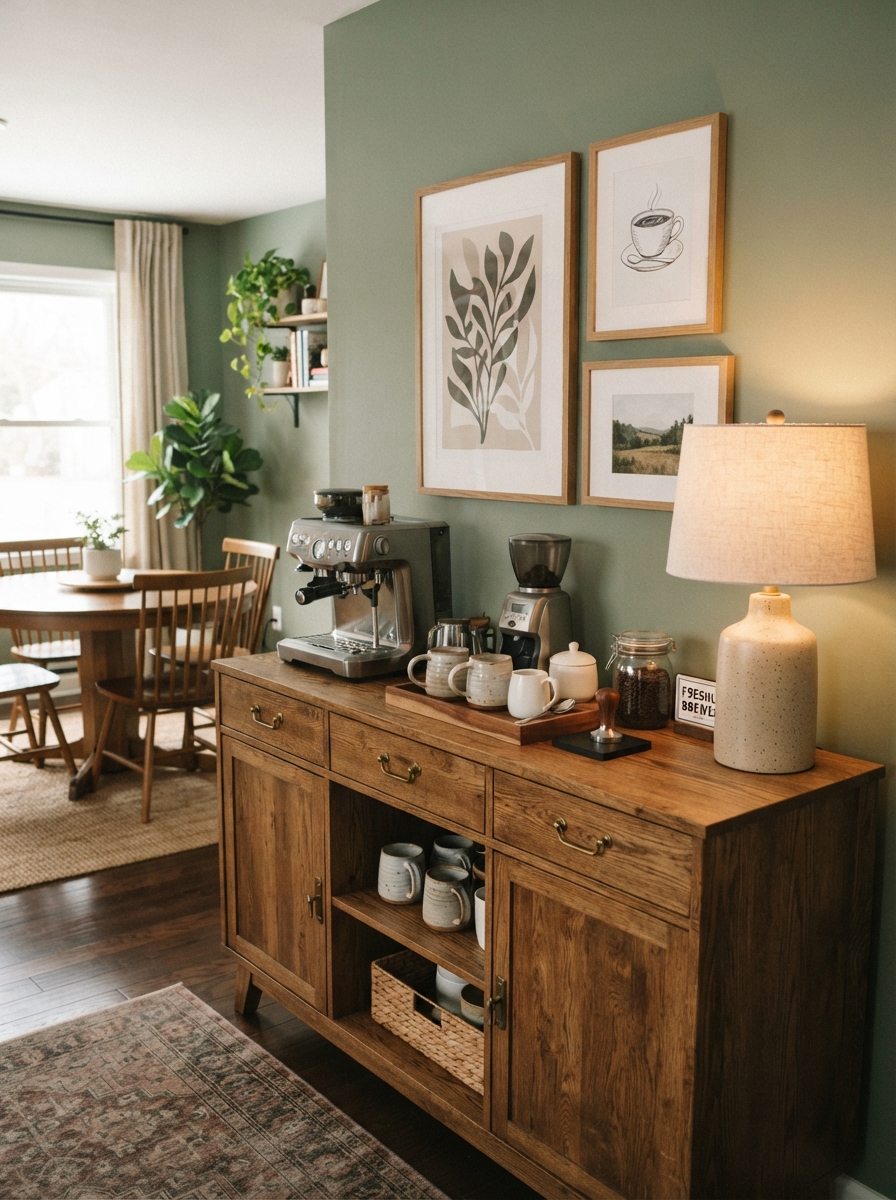
Appliances are the trickiest part of any coffee corner decor plan because they need to be visible and accessible enough for daily use, but they also have cords, pods, and packaging that can make the whole nook look like a convenience store countertop. The solution isn’t hiding everything. It’s containing it correctly.
The tray rule: the single most effective organizational tool
A tray with a raised lip is the first purchase you should make before anything decorative. It corrals the machine, mugs, and brewing tools into one contained visual zone and makes the setup look intentional. It also lifts off the counter so you can clean underneath without dismantling anything. Plan to spend $20 to $45 on a tray with a non-scratch base and a lip tall enough to keep small items from sliding. Everything else builds around it.
Hiding what you don’t want to see
Cord management starts with velcro ties and adhesive cord clips routed down the back edge of the counter and out of the sightline. Opaque canisters handle beans, pods, and sweetener packets so none of that packaging lives on the surface. If your nook has a cabinet above, use it for backup supplies and keep the counter reserved for only what you use every single day.
The one-machine rule for small coffee corners
In a compact kitchen coffee nook under 24 inches of counter width, commit to one brewer. Running a drip machine alongside an espresso setup might seem convenient, but it crowds the counter and undermines the entire aesthetic you’re working toward. Choose the machine that meets most of your daily needs and let the other one live in a cabinet for special use.
Finishing touches for coffee corner decor: plants, lighting, and accents
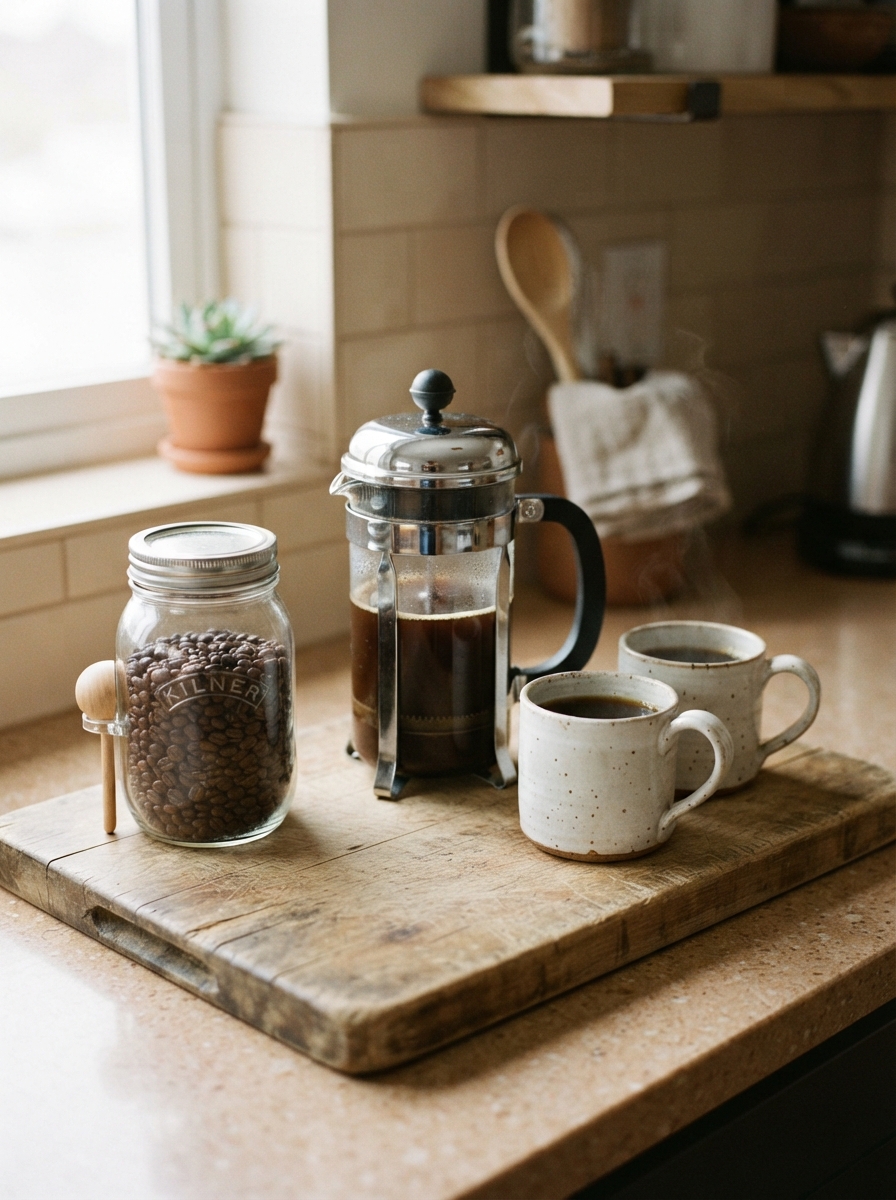
Finishing touches are what separate a coffee corner that looks organized from one that looks designed. These are the small details that do a disproportionate amount of visual work, and none of them require significant spending to pull off well.
Which plants actually work on a small coffee shelf
In low-light conditions, which describe most kitchen nooks, your best options are a pothos in a small ceramic pot, a compact ZZ plant, or a dwarf snake plant variety that stays between four and six inches tall. Limit plants to one per shelf level to avoid visual clutter. A plant placed at the top of a shelf draws the eye upward and adds softness without competing with the mugs or the functional pieces below it.
Layered lighting for a cozy, usable nook
Warm-tone bulbs in the 2700K to 3000K range are non-negotiable for a coffee nook that feels cozy rather than clinical. A small pendant above the counter creates a focal point and signals that the space was thought through. Under-shelf LED strip lights aimed at the work surface solve the task lighting problem without adding visual clutter. For atmosphere, plug-in puck lights placed at the back of shelves add a soft glow. Aim for 200 to 400 lumens for a cozy feel, and push toward 400 to 700 lumens if you also read or work at the nook.
The two-piece accent rule
A tray on the counter plus one wall accent is enough. That wall accent can be a small sign, a piece of coffee corner wall art, or a wall-mounted shelf with a sculptural object on it. Anything beyond two decorative accents starts to cross into visual noise, which is the opposite of the curated, intentional nook you’re building. Restraint is what makes the space feel designed rather than decorated. Related reading: DIY & decor ideas.
Shop the Coffee Corner Look
As an Amazon Associate we earn from qualifying purchases.
Put it together and start tomorrow morning
Here’s your five-layer checklist to act on now. Pick your style from the four options. Confirm your counter dimensions match your machine type. Build your shelf display using the tall, medium, and low layering formula with mixed materials. Organize your appliances with a tray as the anchor. Finish with one low-light plant, warm-tone lighting, and a single wall accent.
That’s the complete system for stylish coffee corner decor you can build tomorrow. It doesn’t require a renovation or a big budget, just intention: knowing what style you’re building toward, respecting the dimensions of your space, and choosing each element because it earns its place. The payoff shows up every morning before you’ve taken your first sip.
Start with the corner you have, the best coffee nook is the one you actually use every morning. And when you’re ready to scale up to a full coffee bar with dedicated cabinetry, a complete appliance plan, and countertop options, the coffee station setup guides on Aesthetic Nest Decor are the natural next step.