


Look at the window ledge in your living room right now. If it’s collecting mail, holding a struggling plant, or simply sitting empty while the afternoon light pours in untouched, you may be leaving one of the most valuable features in your home completely unused. A bay window nobody sits in, an alcove with bare sills, a wide bedroom window with nothing but a curtain rod, all of that is square footage waiting to work for you. Turning any one of them into a window nook is one of the most practical upgrades a small space can get.
A window nook offers something most freestanding furniture can’t fully replicate: built-in seating flooded with natural light. It anchors a reading corner without needing a dedicated room, adds architectural interest to an otherwise plain wall, and creates the kind of cozy, intentional spot that makes a home feel genuinely lived in. At Aesthetic Nest Decor, window seat ideas are central to our small-space reading corner content; this guide works alongside those resources to give you the full picture, from picking the right seat style to finishing the space so you actually use it every day. See also: curtain and window treatment ideas to elevate any room.
Here’s what this article covers: how to match a nook style to your window type, how to measure accurately for a cushion that fits without gaps, how to decide between a DIY build and buying custom, and how to style the finished seat so it works as a real reading corner rather than just a decorative surface.
Want the shortcut?
As an Amazon Associate I earn from qualifying purchases. Some links in this post are affiliate links, at no extra cost to you.
Ready-made bench cushions, storage baskets and reading lights in one place.
Check price on Amazon →What kind of window nook works for your space
Bay window seating: the most versatile option
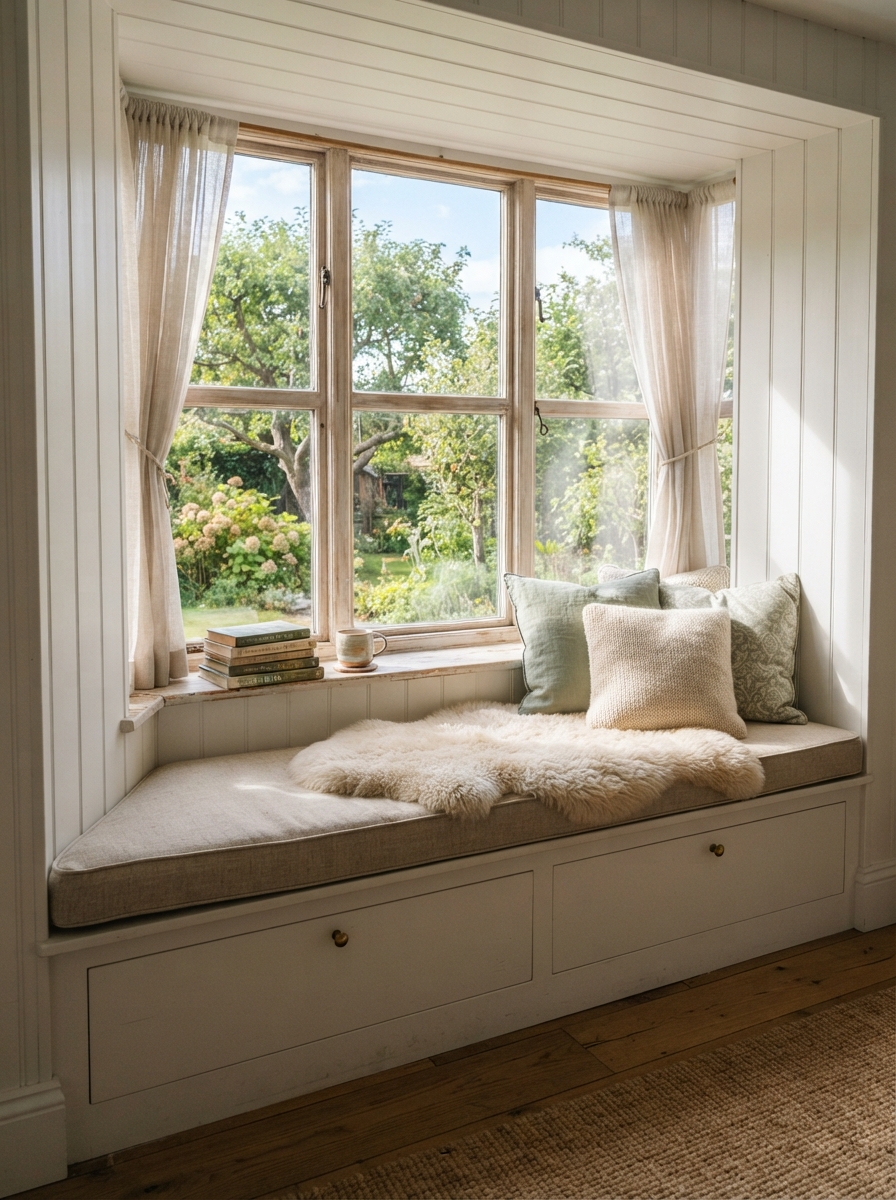
A bay window seat spans the angled or bowed projection of the window, giving you the largest surface area and light coming in from three directions. You can cushion each facet separately or build one continuous platform that wraps the full bay. Either approach typically delivers more usable seating surface than most other options at the same footprint, largely because the bay’s outward projection adds floor area that would otherwise go unused.
The trade-off is precision. Bay windows require section-by-section measurements and almost always need a custom cushion rather than an off-the-shelf size. The angles mean a rectangular cushion won’t fit a trapezoidal space, and gaps at the corners look sloppy regardless of how well everything else is styled. The extra measuring work is worth it. The payoff in visual impact and actual usable seating area is hard to match with any other configuration. You will find more ideas in shelf decor ideas: how to style any shelf like a pro.
Alcove and recessed window seating
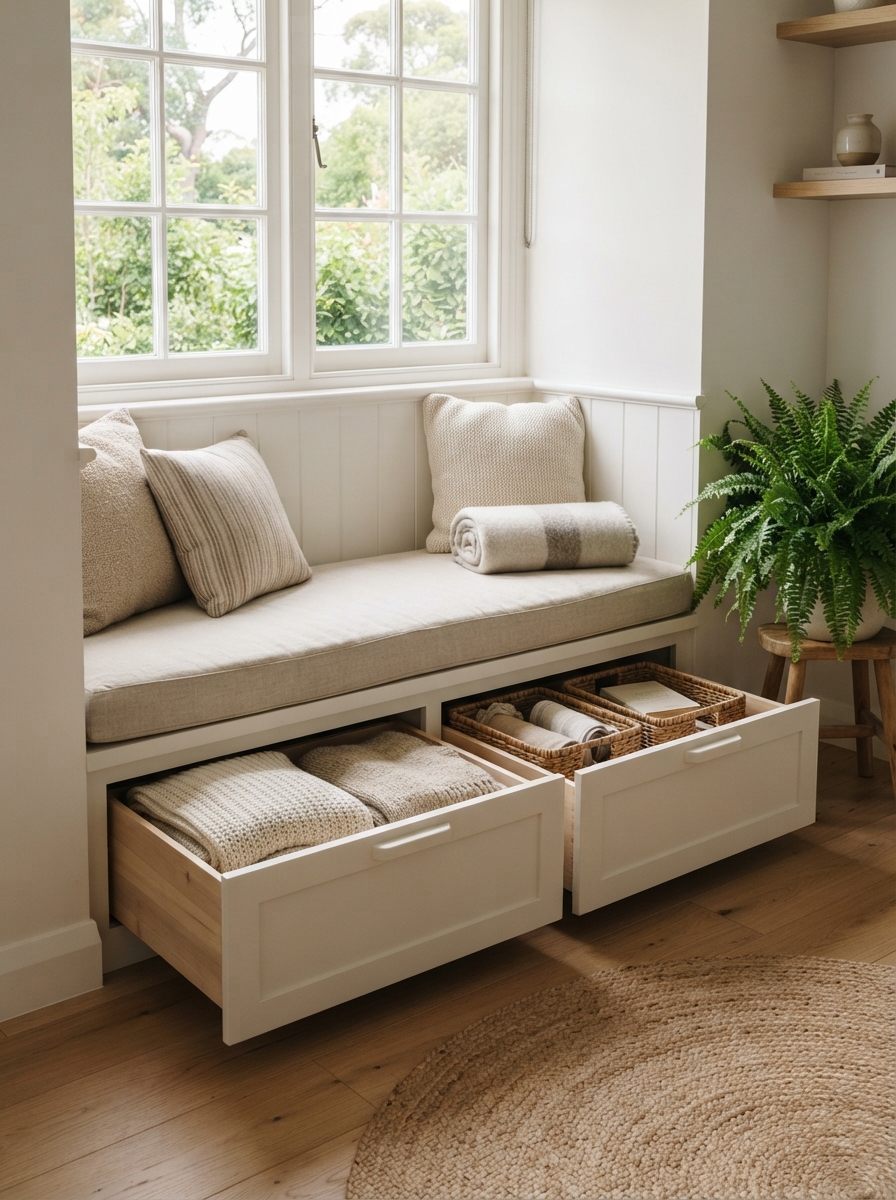
A window alcove is the easiest space to convert because the architecture does most of the framing work for you. Where the window sits inside a recessed wall cavity, the surrounding walls already create a sense of enclosure and privacy. That built-in “frame” makes the seat feel like a destination rather than just a bench pushed against a wall.
This style suits urban apartments and older homes with thick walls, where deep-set windows naturally form an alcove. Your main tasks are adding a base platform, a cushion, and storage underneath. The walls handle everything else, including the cozy, tucked-away feeling that makes a reading nook actually appealing to sit in for an hour at a stretch.
Flat-wall windows with a built-in bench
If your window doesn’t project outward or recess into the wall, you can still create a full window nook by building a bench directly against the wall beneath the sill. A built-in window bench here pulls double duty as extra seating and, with the right seat depth and cushion, becomes a complete reading spot that looks intentional rather than improvised.
This is the most DIY-friendly of the three styles and adapts well to bedrooms, living rooms, and small home offices. The construction is straightforward, the materials are easy to source, and the result looks custom without requiring advanced carpentry skills.
How to measure your window nook before you buy or build
Standard dimensions that make a seat comfortable
For upright sitting and reading, target a finished seat height of 18 inches. The comfortable range runs from 16 to 21 inches depending on cushion thickness and how the seat will be used. Depth matters more than most people expect: 18 to 20 inches works for reading in an upright position, but if you want to curl up with your legs on the seat, go 22 to 24 inches deep.
For length, research-backed guidelines suggest a range of about 32 to 36 inches as a practical minimum for one person seated upright, with 36 inches serving as a reliable target for most builds. Go 48 inches or longer if you want to sit sideways, stretch out, or share the bench with another person or a persistent cat.
Measuring by window type for a cushion that fits
For a bay window, measure each angled section separately: front width, back width, and depth per facet. Label sections left to right so your cushion order matches the actual seat layout. Never assume the sections are identical, even if they look symmetrical at a glance.
For an alcove, measure inside width wall to wall at the narrowest usable point, inside depth from the back wall to the front edge, and clearance height under the sill. Subtract 1/4 to 1/2 inch from total width and depth so the cushion slots in cleanly without binding against the walls or trim. For a built-in window bench, measure the frame opening side to side and the front-to-back depth at seat level rather than at the floor, where the dimensions may be slightly different.
The paper template trick that prevents expensive mistakes
Lay craft paper over the entire seat surface, trace the exact outline, and trim it until it sits flush against every edge and corner. This template travels with your measurements when you order a custom window nook cushion, and it catches out-of-square walls or unexpected angles that a tape measure alone will miss.
For bay windows especially, this step is strongly recommended. It’s the difference between ordering a rectangular cushion for a trapezoidal space and receiving a cushion that actually drops in without gaps.
DIY window seat vs. buying custom: choosing what fits your budget
What a basic DIY build involves
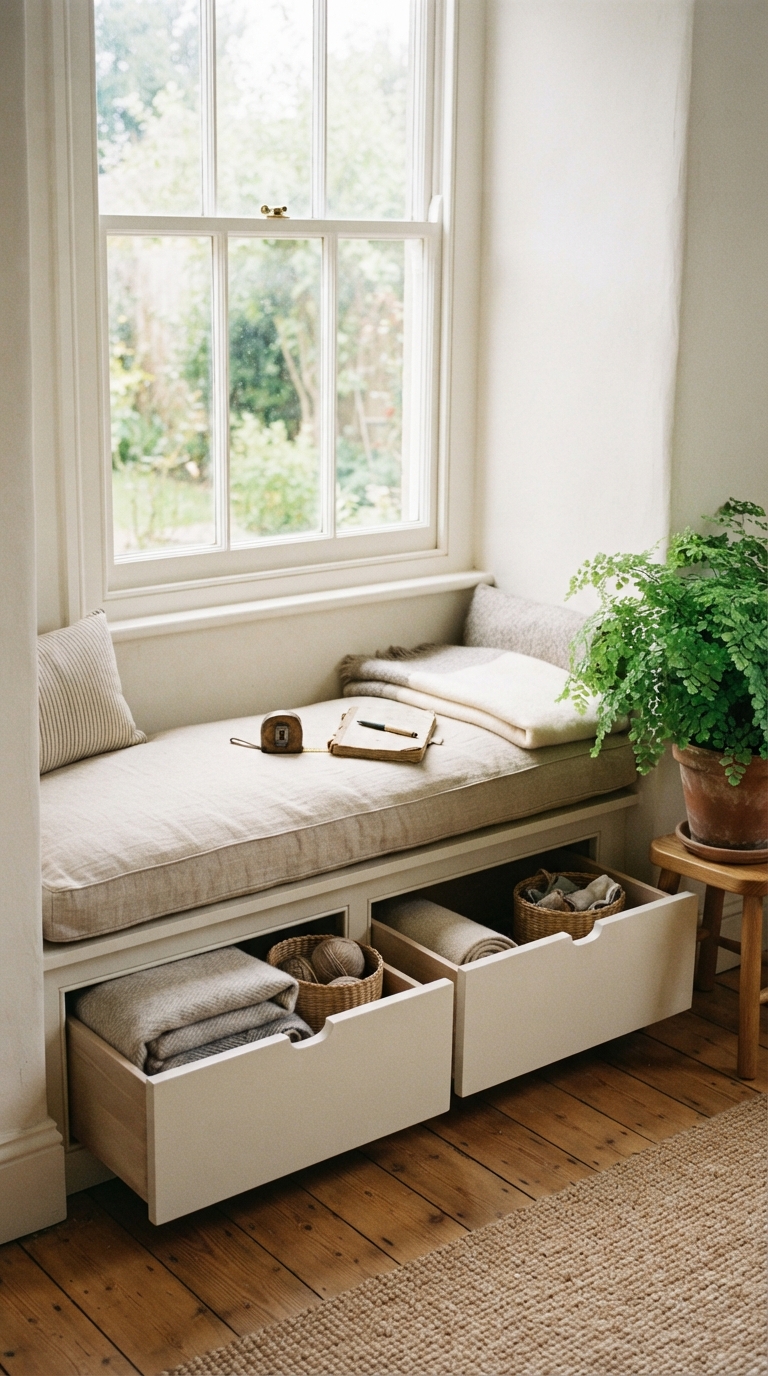
The most common DIY approach is a lift-top storage bench: a framed box anchored to wall studs, topped with a hinged lid that opens for access to hidden storage underneath. The structure uses a 2×4 base frame, 3/4-inch plywood for the sides and seat top, a piano hinge for the lid, and trim to create a finished built-in look. Materials for a 36-inch bench typically run $100 to $250 for the structure alone, before any cushion costs.
The build follows eight main steps: measure and locate studs, build and level the base frame, add vertical supports and internal bracing, attach plywood panels, install the hinge and lid, add trim, fill and paint, then top it with a cushion. None of these steps require advanced skills, but the project does demand patience with measuring and a willingness to make small adjustments as you go.
Cost comparison: low, mid, and high ranges
Before committing to any path, it helps to see the real numbers side by side. These figures are aggregated estimates across multiple sources and will vary by region and material availability:
- DIY materials: $25, $60 for a basic build; $300, $700 or more for premium plywood, custom trim, and higher-end finishes
- Custom window seat cushion: $90, $150 at entry level; $600, $800 or more for high-end fabric and fill
- Prebuilt window bench: $150, $400 for flat-pack options; $1,500, $3,000 or more for a fully custom built-in
DIY makes sense when you’re comfortable with basic carpentry and want exact control over dimensions. Buying custom or prebuilt makes more sense when the space has unusual angles, your schedule is tight, or you don’t have access to the tools the build requires.
Cushion fill and fabric choices that hold up over time
The best foam for a window seat cushion
High-density polyurethane foam at 2.0 lb density or higher holds its shape under daily use and resists the compression and sagging that lower-density foam develops with regular sitting over time. For a reading nook where you spend stretches of an hour or more in the same spot, foam density is one of the most important decisions you’ll make about the cushion.
A memory foam top layer of 1 to 2 inches over a high-density base gives you softness for lounging with the structural support of firm foam underneath. That combination handles both upright reading posture and curled-up lounging without forcing you to choose between comfort and longevity.
Fabrics that work in sun-exposed nooks
Solution-dyed acrylic fabrics resist UV fading, repel moisture, and are significantly more fade-resistant than most indoor upholstery fabrics when used in direct sunlight. Sunbrella is one of the most widely recognized brands in this category and a reliable choice for any window seat cushion that gets regular sun exposure. If the nook doesn’t face strong direct sun, performance fabrics like Crypton or Revolution handle spills and pet contact better than linen or cotton blends without the outdoor-fabric look.
For a purely decorative cushion in a low-traffic space, a velvet or linen blend looks warm and adds texture, but it needs more care and will need replacing sooner than a performance fabric. Regardless of which fabric you choose, order a zippered removable cover. Cleaning a window seat cushion cover in the washing machine beats calling an upholstery cleaner every time.
Styling your window nook as a reading corner
Built-in shelving that earns its place in a small space
Floating shelves on the side walls of the nook keep books within arm’s reach without eating into floor space. A shelf depth of 8 to 10 inches handles most paperbacks and standard hardcovers without jutting out far enough to feel intrusive in a tight space. If you want shelves that hold larger books or storage baskets as well, 10 to 12 inches gives you that flexibility without making the nook feel crowded.
If the nook sits in an alcove, recessed shelving on either side of the window creates a symmetrical built-in library look. This is exactly the kind of small-space reading corner styling that Aesthetic Nest Decor explores in depth across its reading nook content, including approaches for different room sizes, shelf configurations, and storage combinations worth browsing before you finalize your layout.
Lighting that makes reading actually comfortable
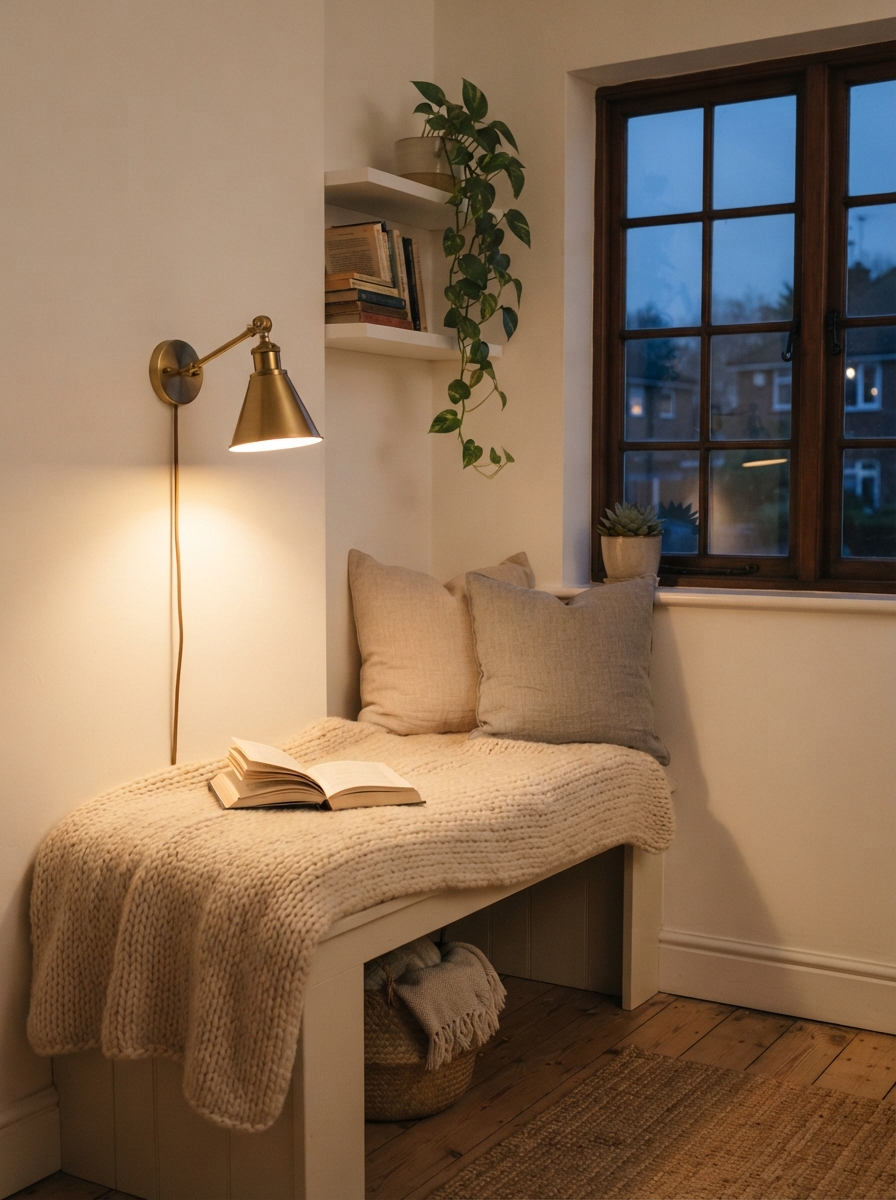
Natural light is the starting point, but it disappears at dusk and changes significantly by season. A plug-in wall sconce or a clamp-style reading light mounted at shoulder height solves this without requiring an electrician. Position the light source behind or just above your shoulder rather than directly in front of you to reduce shadows on the page.
Warm white bulbs in the 2700 to 3000K range reduce eye strain during long reading sessions without making the nook feel harsh or clinical. String lights looped along the top of the nook or tucked along a shelf add atmosphere without heat or glare, and they work especially well in alcove-style spaces where the enclosure amplifies the warm glow.
Layering pillows, throws, and small finishing details
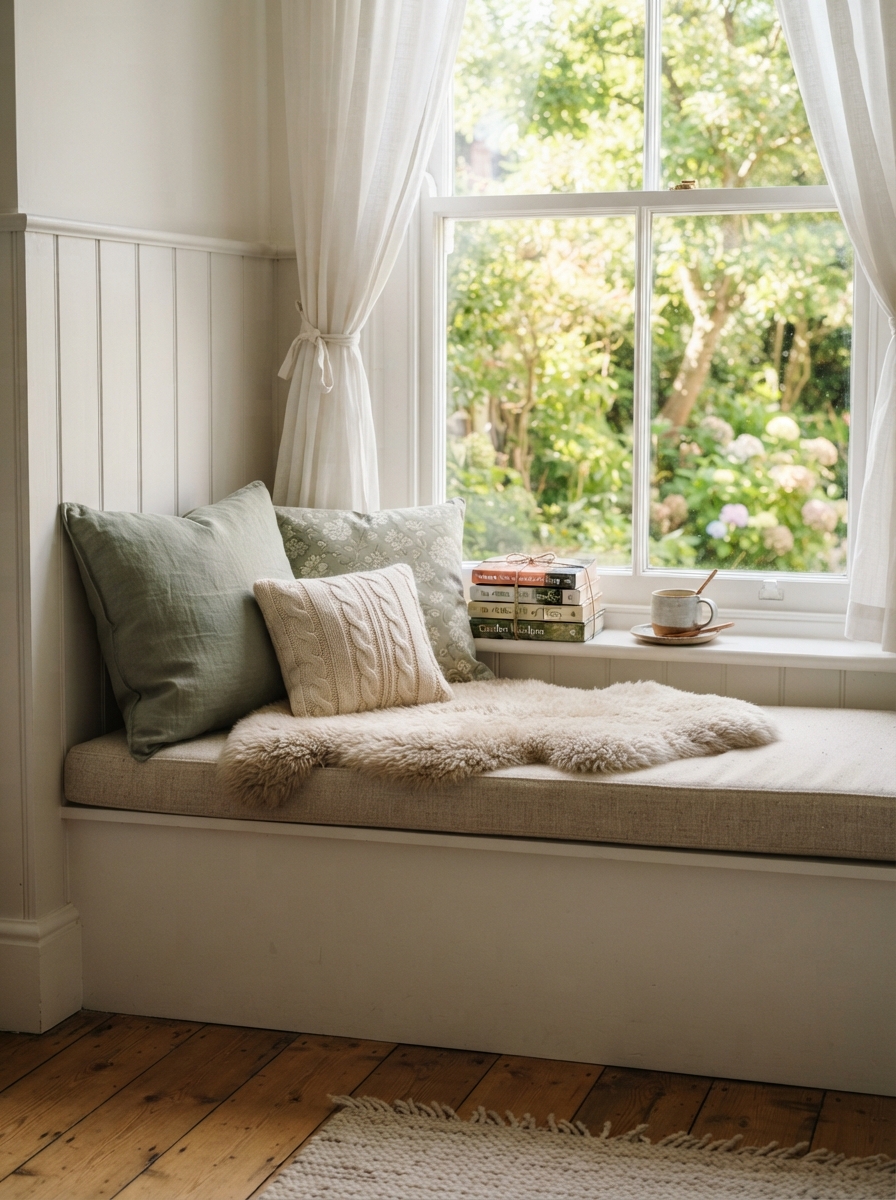
Two to three pillows at different sizes give the window seat a styled, intentional look without making the seat unusable. A 20×20 square, an 18×12 lumbar, and a smaller accent pillow in coordinating but not matching fabrics creates depth without overwhelming the seat. Choose pillow covers that share a color family with the main cushion rather than matching exactly; the slight variation reads as deliberate rather than mismatched.
A lightweight throw folded over one end of the bench and a small tray or side table within reach are the details that make the nook feel genuinely used rather than staged for photos. Those finishing touches signal to everyone, including yourself, that this is a spot worth settling into.
Putting it all together
The path from unused window ledge to fully functional reading corner follows a clear sequence: identify your window type, measure with precision using the paper template method whenever there’s any doubt, decide between a DIY built-in bench and a custom or prebuilt option based on your budget and skill level, then choose a cushion fill and fabric built for how the nook will actually be used. Layer in shelving, the right lighting, and enough softness to make the space worth returning to every day.
A window nook doesn’t require a full renovation or a designer’s budget. The architectural feature is already there in your home, whether it’s a bay window, a recessed alcove, or a flat wall beneath a wide sill. The work is in fitting it out thoughtfully rather than leaving it to collect dust.
For more ideas on cozy reading corners, book storage solutions, and small-space nook configurations that work in real homes, explore the reading nook and small-space styling guides on Aesthetic Nest Decor. The guides cover specific window types, room layouts, and budget tiers, useful if you’re ready to move from planning to building. More on that in kitchen coffee nook ideas.
Window nook shopping list
- Bench seat cushion — get the depth right before the fabric
- High-density foam — 1.8 lb or denser so it holds its shape
- Performance-fabric covers — survives direct sun without fading
- Lidded storage baskets — hides what the drawers cannot
- Plug-in wall sconce — light beside you, no wiring
- Chunky knit throw — the layer that makes it look finished
Prices and availability change. Links open on Amazon.
Frequently asked questions about window nooks
How do I measure a window nook cushion?
Start by measuring the width at the widest and narrowest points, the front-to-back depth at seat level, and the height clearance under the sill. For any space that isn’t a perfect rectangle, especially a bay window nook, cut a paper template first. Trace the full outline, test it for fit, and send the template along with your measurements when ordering a custom cushion. This single step prevents the most common and most expensive ordering mistakes.
What are the best fabrics for a window nook cushion?
For sun-facing nooks, solution-dyed acrylic is the most durable choice because it resists UV fading and repels moisture. For shaded or low-traffic spaces, performance weaves like Crypton or Revolution offer good stain resistance with a more interior-forward look. If the nook is purely decorative and out of direct sun, velvet and linen blends work well but require more upkeep. Whatever fabric you choose, specify a zippered removable cover so cleaning stays simple.
Can I build a window nook without advanced carpentry skills?
Yes, particularly with a flat-wall bench build. The core structure, a framed box anchored to studs, topped with a plywood lid, uses basic tools and standard lumber that’s easy to source. The steps that demand the most care are measuring accurately, keeping the frame level, and fitting trim cleanly. Bay window builds add complexity because of the angled sections, but even those are manageable with careful templating and patience. Alcove conversions fall somewhere in between, since the surrounding walls do much of the structural work for you.