
You spend a Saturday getting the entryway under control. Everything has a spot. It looks great. Then two days pass, and somehow there are four coats on the floor, three pairs of shoes blocking the door, and a backpack hanging from the doorknob like a white flag. If that cycle sounds familiar, the problem isn’t your family, it’s that the space has no real system built into it.
As an Amazon Associate I earn from qualifying purchases. Some links in this post are affiliate links, at no extra cost to you.
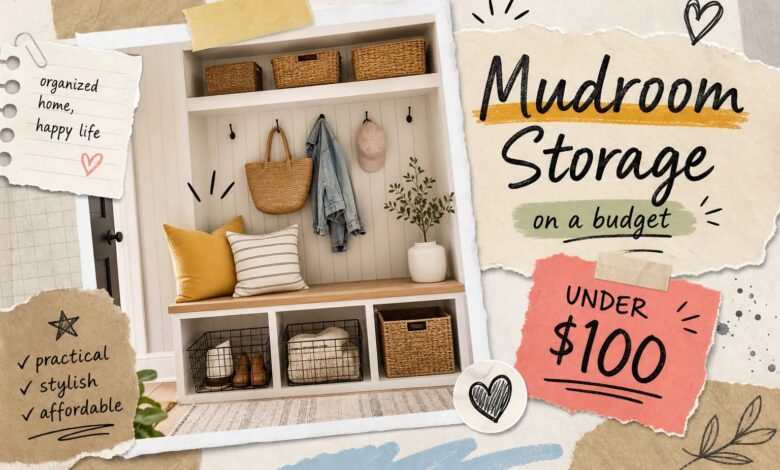
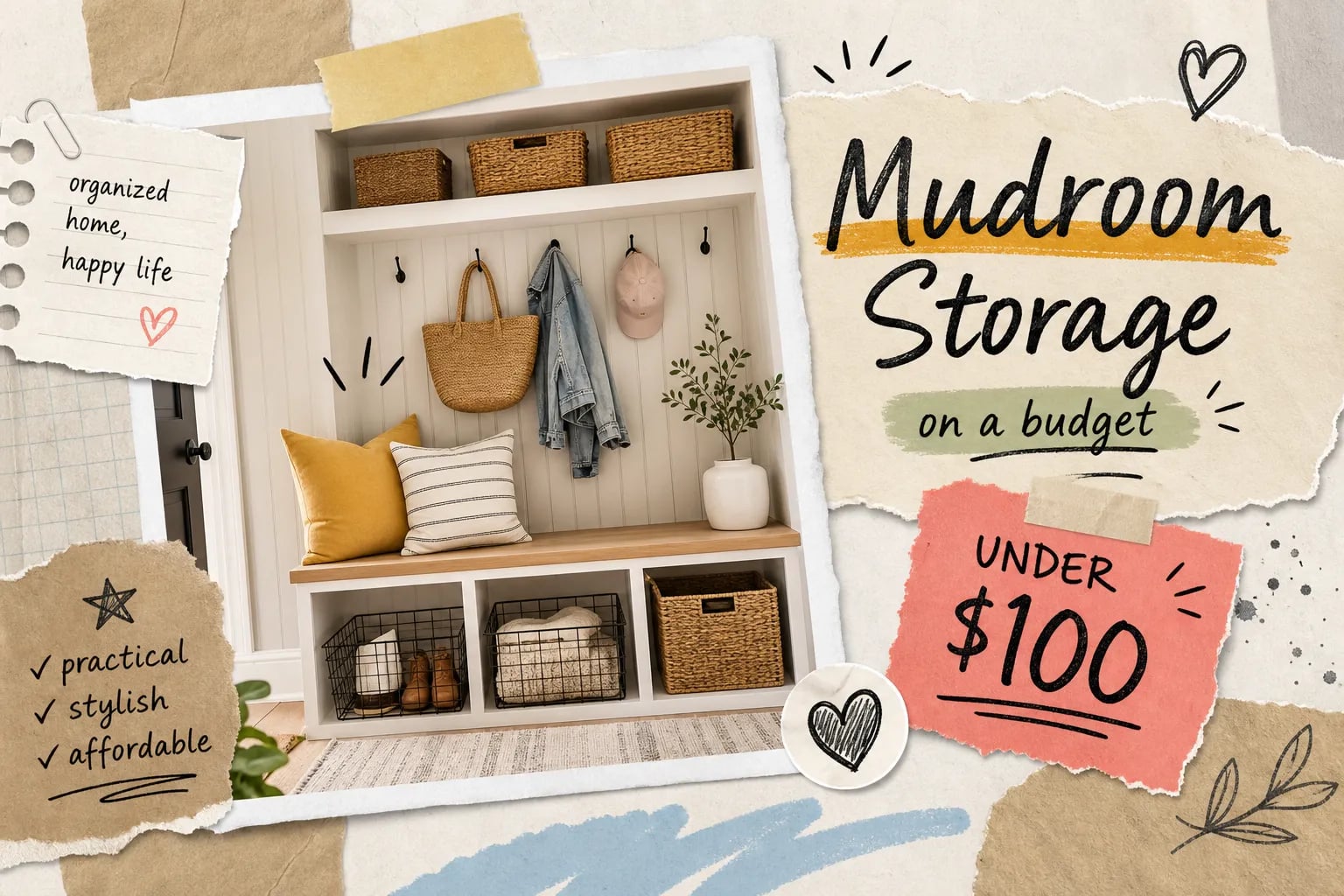
This article covers the best mudroom storage solutions on a budget, most of them under $100, including what you can build yourself versus what you can grab off a shelf this weekend. These affordable mudroom ideas work whether you’re dealing with a dedicated room, a narrow hallway, or a single stretch of wall. You don’t need a contractor or a custom built-in to make this work. You need the right anchor piece, a clear layout plan, and a realistic budget matched to your space. By the end, you’ll have a short list of strategies ranked by fit for your home, a cost estimate you can actually use, and one project ready to start.
Before you buy anything, map out your three mudroom zones
Why layout beats product selection every time
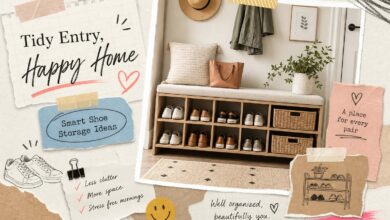
A mudroom fails when stuff lands wherever it fits, not where it belongs. Before you buy a single hook or basket, assign three distinct zones to your wall or alcove: a drop zone for bags and coats, a shoe zone at floor level, and a catch-all zone for keys, mail, and seasonal items. When each zone has a physical location, every family member knows where things go without being reminded.
For the full range of options at every budget, see our guide to 30 smart mudroom storage ideas.
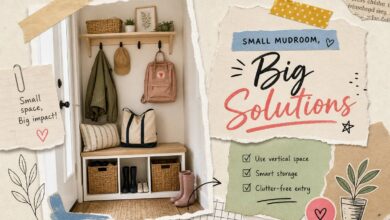
For reference, 5 ft x 6 ft is the smallest useful mudroom footprint for a dedicated room. Hallway-style setups can work with as little as 18, 24 inches of depth along one wall, as long as you preserve at least 36 inches of clearance in front of all storage so the space doesn’t turn into an obstacle course. Plan for a bench seat at 18 inches high, adult hooks at 60, 66 inches off the floor, and kids’ hooks at 36, 48 inches depending on their age. Getting these numbers right before you buy anything saves you from returning a bench that’s too tall or a hook rail that puts everything out of reach for the five-year-old.
If you’re planning a larger entryway overhaul alongside this project, Aesthetic Nest Decor’s room-by-room decor guides walk through full entryway layouts, from hook placement to bench sizing, so you can map the whole transformation before spending anything. Working through that full picture first gives you a concrete plan rather than a pile of purchases that don’t quite connect.
Best mudroom storage solutions on a budget: wall hooks and peg rails under $30
What weight rating actually matters for coats and backpacks
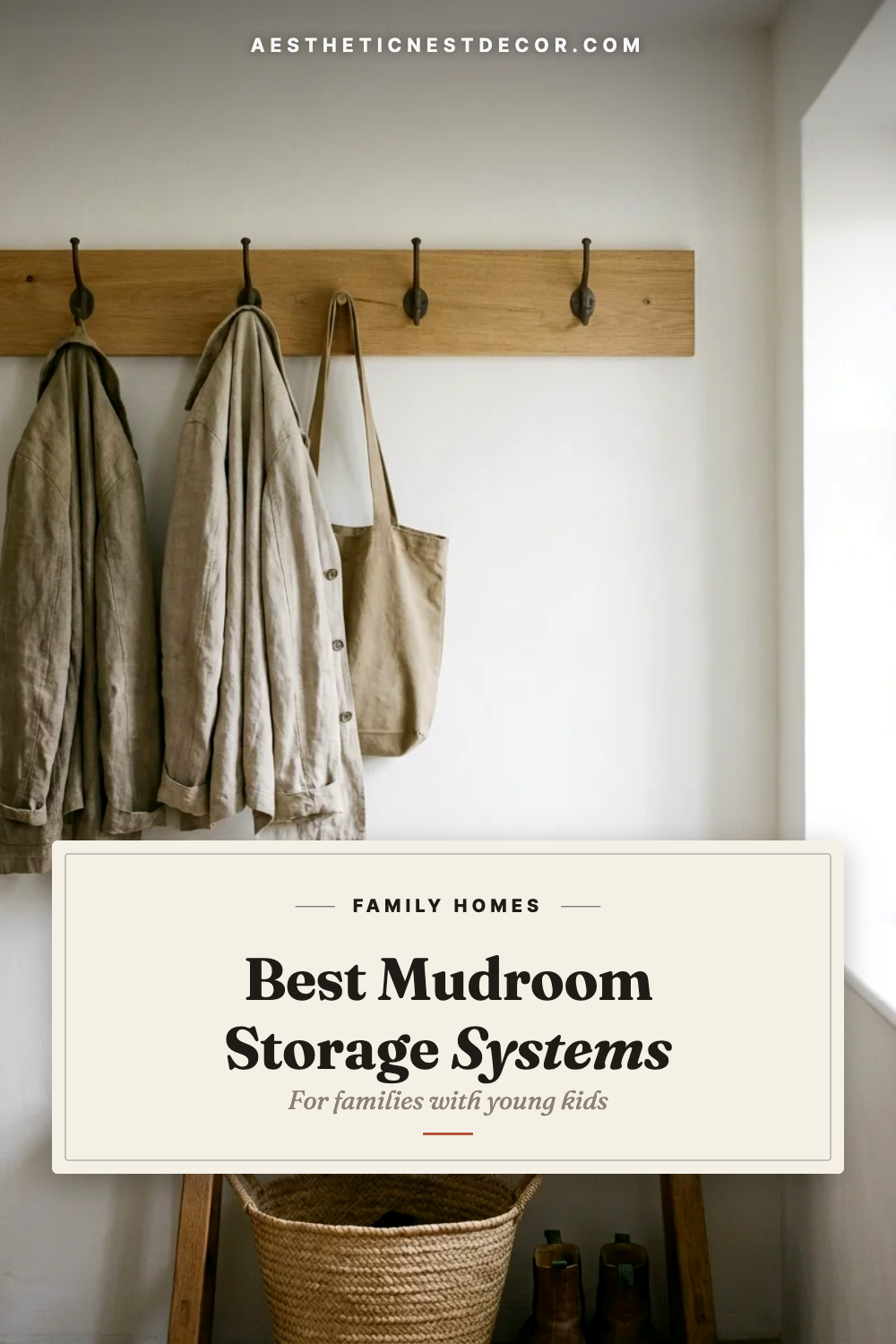
For heavy winter coats and loaded school backpacks, the minimum reliable weight rating is 30 lb per hook, with 35, 40 lb being the safer target. That rules out most adhesive and magnetic options, which aren’t built for daily use with kids’ gear. When you’re shopping, always check whether the rating assumes stud mounting or drywall anchors, because the difference is significant. Hooks mounted into studs hold far more weight and are the smarter choice anywhere kids are dropping backpacks every afternoon.
Good options in the $9, $30 range include the Bussdis Heavy Duty hooks (rated at 30 lb), the CBWLWJ double hooks and ZEYU folding hooks (both rated at 40 lb), and the HADWER wall hooks (35 lb). Think of these as the category to look for rather than a rigid shopping list, any screw-mounted hook with a 30, 40 lb rating from a hardware store or Amazon will do the job. Space them 8, 12 inches apart so coats can hang without tangling and actually dry between wears.
If you want more flexibility than a single hook rail offers, a pegboard panel is worth considering. A basic pegboard system runs about $20, $200 depending on size, and it lets you rearrange hooks, small shelves, and bins as your storage needs change. For a family with shifting seasonal gear, that adaptability pays off quickly. A single 2×4-foot panel painted to match the wall looks intentional rather than utilitarian, and it’s one of the cheapest mudroom storage upgrades you can make.
Build a DIY mudroom bench with cubbies for under $100
What to buy at the hardware store
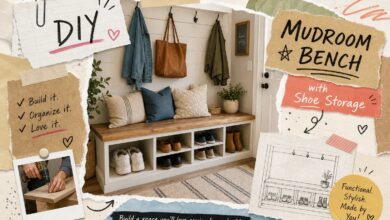
A simple open-cubby bench built from sheet goods is achievable under $100 if you keep the design straightforward. The core materials are one to two sheets of 3/4-inch plywood or MDF ($40, $60 depending on your local lumber yard), 2×4 lumber for internal supports, wood screws, wood glue, sandpaper, primer, and paint. Lumber alone typically runs $40, $90; hardware and finish add the rest. Skip decorative trim and corbels to stay on budget, they add cost without adding function.
On the material choice: MDF is cheaper and takes painted finishes beautifully, but plywood holds screws better and handles moisture and daily abuse more reliably. For a bench that’s going to see wet boots and kids sitting on it every day, 3/4-inch plywood is worth the slight price premium over MDF, especially for the seat and structural sides.
Weekend build sequence: finish it in a Saturday
Work through these steps in order:
- Measure the wall space and decide the bench width, height, and number of cubbies.
- Cut sheet goods into the bench top, bottom, sides, cubby dividers, and back pieces.
- Build the cubby box by attaching dividers to the top and bottom panels with glue and screws.
- Add 2×4 supports inside so the bench holds adult sitting weight without flex.
- Attach the bench seat to the cubby base.
- Secure the whole unit to wall studs with long screws for stability.
- Sand, prime, and paint.
- Add baskets, bins, or hooks to finish the look.
A bench between 36, 48 inches long is right for a small entryway. Keep cubbies 12, 15 inches deep to save space while still fitting shoes and folded items. Most first-time builders finish the basic structure in 4, 6 hours with pre-cut panels, which makes this a legitimate Saturday project rather than a multi-weekend commitment.
Ready-made mudroom storage from IKEA and Target worth buying
IKEA picks that look more built-in than they are
The KALLAX shelf unit is the most budget-accessible IKEA option for a mudroom setup, currently around $79.99 in the U.S. (or $64.99 with an IKEA Family membership). The classic hack is to lay a KALLAX unit on its side and use it as a bench base, topped with a cushion and flanked by wall hooks above. Total cost for this setup can stay under $100 for a small unit if you already have a cushion or source one separately. The cubbies fit shoes, baskets, and folded items, and the horizontal orientation gives you a clean, low-profile look that works in tight entryways. You will find more ideas in entryway & mudroom.
The TRONES shoe cabinet is the other standout for narrow spaces. At just 7 inches deep, it’s one of the slimmest shoe storage options available and works in hallways where anything deeper would block traffic. For more comprehensive storage with doors and a closed, locker-style look, the PAX wardrobe combination runs $229, $399, and the BESTÅ combination sits at $655. These are well above the $100 mark, but they’re worth knowing about if you’re planning a longer-term system where you add pieces over time.
Target and other retailers for tight budgets
IKEA isn’t always nearby or practical, and that’s okay. Target carries wall-mounted cubbies, entry benches, and hook-and-shelf combos in the $40, $100 range. The Brightroom 3-Tier Entry Bench with Hooks is currently available at $95, which makes it one of the more complete standalone solutions at that price. Amazon and Walmart also carry entry bench options with shoe storage and padded seats in the $60, $100 range under brands like SONGMICS and VASAGLE.
These ready-made units are the right call when you want the space finished this weekend without any building. They’re also a practical option for renters who can’t mount heavy built-ins to the wall. The tradeoff is that you’re working with standard dimensions, so an awkward-width hallway or a non-standard alcove may not get a clean fit.
DIY vs. ready-made: how to pick based on your space and situation
When building is the smarter call
If the entryway is an awkward width, sits between two walls at a non-standard measurement, or needs a specific finish to match existing trim, a DIY build wins every time. You cut it to fit, paint it to match, and get more storage square footage per dollar than any comparable ready-made unit in the same price range. A DIY bench with open cubbies built from plywood delivers more usable storage for $80, $100 than any mass-market bench at that price, because you’re paying for materials rather than assembly and packaging.
DIY also makes sense when the budget needs to stretch as far as possible. If you have a full wall to work with and need hooks, cubbies, and a bench all at once, building the bench yourself and spending the remaining budget on quality hooks gives you a complete low-cost entryway organization system under $100. The ready-made route at that budget gets you one piece, not a system. Related reading: budget Home gym: build your full setup for under $500.
When to buy ready-made and how to mix both approaches
Ready-made wins for renters, for anyone with limited time, and for spaces that IKEA units fit cleanly without modification. The most practical approach for many homes is a hybrid: buy a ready-made unit, a KALLAX or TRONES, as the anchor piece, then complement it with DIY wall hooks or a custom peg rail above to maximize vertical space. This mix-and-match method keeps the total cost under $100 while creating a more layered, functional setup than either approach delivers on its own.
Best mudroom storage solutions on a budget: quick comparison
Not sure which approach fits your situation? Here’s a fast breakdown to help you decide:
| Option | Approx. Cost | Best For | Tradeoff |
|---|---|---|---|
| Wall hooks / peg rail | $9, $30 | Renters, fast fixes, drop zones | No shoe or seat storage |
| DIY cubby bench (plywood) | $80, $100 | Homeowners, custom-width spaces, tight budgets | Requires tools and a free Saturday |
| IKEA KALLAX bench hack | $80, $100 | Standard hallways, renters who want furniture-grade looks | Fixed dimensions, requires a cushion |
| Ready-made entry bench (Target / Amazon) | $60, $100 | Tight timelines, no-tool setups | Standard sizes may not fit all spaces |
| Hybrid (ready-made base + DIY hooks) | $80, $100 total | Most households, best balance of speed and function | Requires two separate sourcing steps |
Your weekend mudroom project: narrow it down and start
How to pick one starting project from everything covered here
Go back to the three zones from the first section. Every solution you consider should clearly serve at least one of those zones. If you’re a renter in a narrow hallway, a TRONES cabinet plus a simple peg rail handles both the shoe zone and the drop zone without a single screw into a stud. If you’re a homeowner with a 4-foot alcove and three kids, the DIY cubby bench is the right first project because it solves shoes, bags, and seating in one build. The zone framework is the filter that turns a list of cheap mudroom storage ideas into an actual decision.
Four steps to get started this weekend
- Step 1: Measure the wall or alcove and decide which zones you’re solving for in this first project.
- Step 2: Pick one anchor piece, whether that’s a DIY cubby bench, a KALLAX setup, or a peg rail, and commit to finishing it before adding anything else.
- Step 3: Source the materials or the ready-made unit and clear the entryway.
- Step 4: Install, test it for a week, then decide whether a second piece (hooks above the bench, a TRONES by the door) is actually needed or if the first piece solved it.
The best mudroom storage solutions on a budget aren’t the most elaborate ones. The systems that work long-term are the ones that match how your family already drops things when they walk in the door. Build around that habit, not against it, and the space will stay organized without anyone having to think about it.
Start with one piece and build from there
You don’t need a custom built-in or a contractor to get a mudroom that works. A simple peg rail at $15, $30, a KALLAX bench hack for around $80, $100, a DIY cubby bench built from plywood, or a ready-made entry bench from Target all solve the same core problem: a designated place for things to land that isn’t the floor. The difference is which one fits your wall, your budget, and your weekend. These are budget mudroom ideas that any homeowner or renter can pull off without professional help.
If the entryway project has you thinking about the rest of the home, Aesthetic Nest Decor’s room-by-room guides cover everything from compact kitchen layouts to bedroom refresh ideas, so you can keep the momentum going one space at a time. The entry is a great place to start because a functional front zone sets the tone for everything else.
Pick the one solution that fits your space this weekend. Get it installed before you start planning the next upgrade. A mudroom that’s 80% done and actually being used is worth more than a perfect plan that’s still sitting on a Pinterest board.
Budget Mudroom shopping list
- Peg rail with hooks — the cheapest capacity you can add
- Flat pack storage bench — under budget, does the job
- Fabric storage bins — soft, cheap, hides everything
- Boot tray — stops the floor problem
- Adhesive wall hooks — renter friendly, no tools
- Stackable shoe rack — vertical beats floor space
Prices and availability change. Links open on Amazon.
Frequently asked questions about budget mudroom storage
What are the best mudroom storage solutions for renters?
Renters should focus on freestanding and low-impact options. A TRONES shoe cabinet requires only two small wall anchors, a KALLAX bench sits flat on the floor without wall mounting, and a peg rail with drywall anchors leaves minimal damage. The hybrid approach, a freestanding bench plus a removable hook rail, gives you full zone coverage without risking a security deposit.
How do I mount wall hooks safely without hitting a stud?
Use toggle bolts or expansion anchors rated for the load you’re hanging. For hooks carrying coats and backpacks (10, 20 lb per hook is realistic with kids), a toggle bolt rated at 50 lb per anchor gives you a solid safety margin. Avoid plastic drywall anchors for anything heavier than a lightweight jacket. If you can locate a stud with a stud finder, a 2.5-inch wood screw into the framing is always the stronger choice.
Can I build a mudroom bench for under $100?
Yes, with a straightforward design. One to two sheets of 3/4-inch plywood ($40, $60), basic hardware ($10, $15), and paint or primer ($10, $20) keeps the total at or under $100 if you shop standard lumber pricing. The key is skipping decorative details, open cubbies, no face frames, no corbels, and focusing purely on function for the first build.
What’s the most affordable mudroom furniture for small entryways?
For small spaces under 24 inches deep, the IKEA TRONES at roughly $35, $50 per unit is hard to beat for shoe storage per dollar. A wall-mounted peg rail with a small floating shelf above it handles coats and bags for under $40 total. For full bench-plus-storage in one piece, the Target Brightroom bench at $95 or an Amazon entry bench in the $60, $80 range covers the most ground at the lowest price point without any building required.